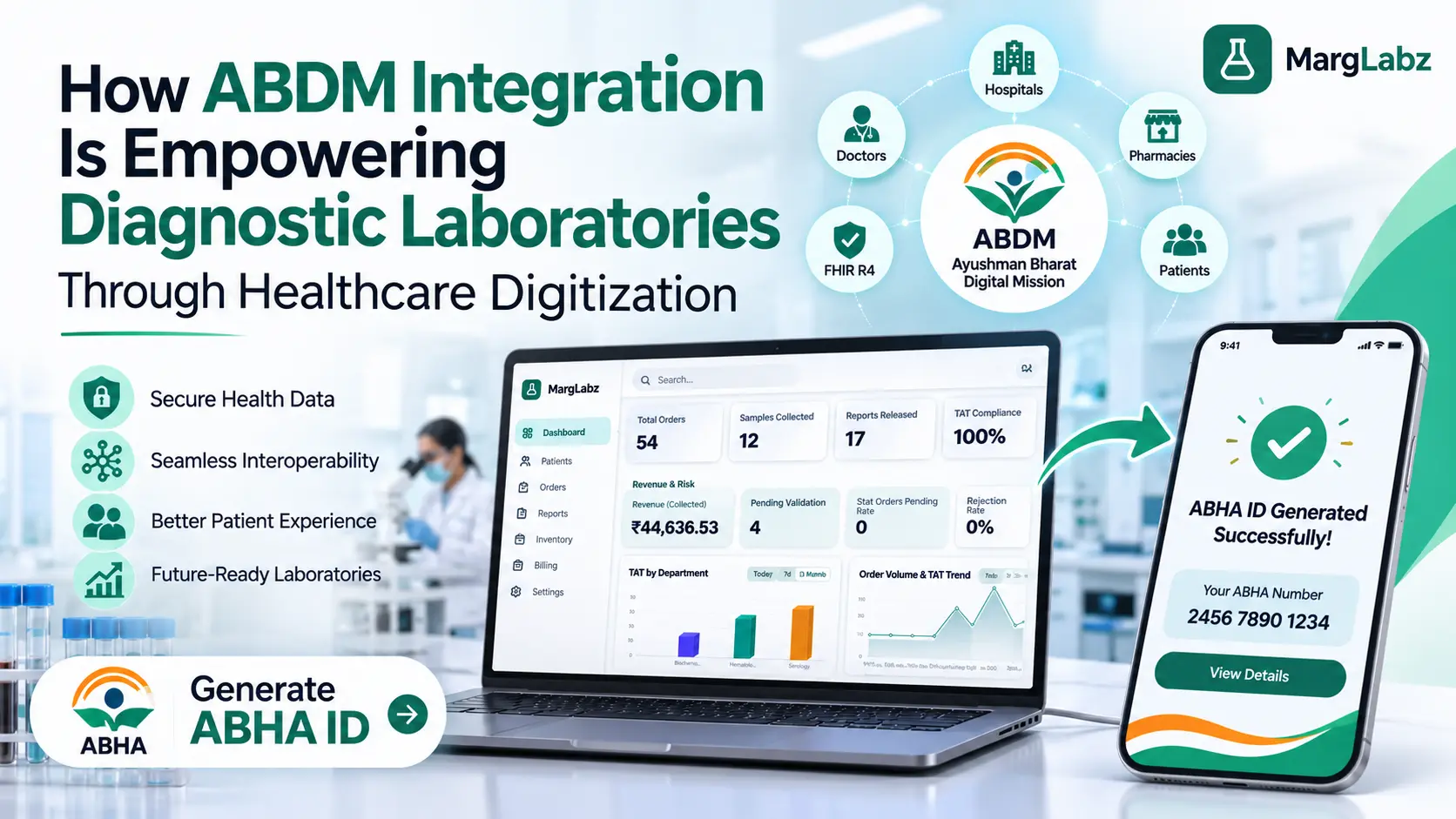
A patient comes to a diagnostic lab in the middle of a very busy day. They have a printed prescription and an older thyroid report from a different location. The receptionist takes down all of the patient's information, puts the older report in a file and then, next month, that same patient wants a copy of it but cannot find it anywhere. This scenario happens multiple times every single day to hundreds of patients, and it is what ABDM integration was developed to help solve.
The integration of the ABDM (Ayushman Bharat Digital Mission) with a laboratory's software provides access to the Indian national digital health network. This allows for laboratory reports to be linked to a patient's ABHA (Ayushman Bharat Health Account) and only shared after the patient has given consent. This document is intended as an overview of how the integration of the ABDM will work in a diagnostic laboratory the key concepts involved questions you should ask your software vendor and what you should consider prior to integrating.
What Is Ayushman Bharat Digital Mission (ABDM)?
In September 2021, the Government of India launched the Ayushman Bharat Digital Mission with the goal of creating a single national digital health ecosystem. As reported by the Press Information Bureau (PIB) the mission has connected more than 1.04 billion health records with more than 930 million ABHA accounts by July 2026.
In general terms, ABDM creates a common rail system: identification (ABHA), directories of providers and organizations, and a means for sharing health-related records with patients’ permission. All health care providers – hospitals, clinics, labs, and pharmacies – connect their individual software to these same rails.
Understanding ABHA and Its Role in Digital Healthcare
The PIB states that an ABHA (Ayushman Bharat Health Account) is a person's individual health identity. An ABHA number is a 14-digit, unique health identification number which enables a person to link their medical records from multiple sources including hospitals, laboratories, insurance companies, and other national health programs, with the permission of the patient.
Two terms are often confused:
ABHA number: the 14-digit identifier.
ABHA addresses are like email addresses (e.g. username@domain) but they are human readable. According to the NHA guidelines, these addresses would be represented as xyz@abdm. In this example, the domain would identify the consent manager.
ABDM vs ABHA: ABDM is the mission, and the entire ecosystem. ABHA is the patient's identity in the ecosystem.
Why Is ABDM Integration Important for Diagnostic Laboratories?
Because diagnostic laboratories produce a significant portion of all clinical data that patients have, integration is important for four different reasons.
- Patient identification. A registration that is verified by ABHA will help reduce the number of times a single person has multiple records in the system, and will also help to prevent mistakes in matching up the correct record with the correct patient.
- Digital medical records. The reports associated with each ABHA remain with the patient regardless of which provider they are seeing, as opposed to remaining in only one lab's file.
- Interoperability. Standardized records may be accessed by other systems which are compliant with the ABDM, such as those used by a doctor's office.
- The Patient Experience. The PIB mentions a study conducted by IIHMR about the Scan and Share service, where patient waiting times for registering were reduced from approximately one hour to two to five minutes. Since this study was done on registration for outpatient services within a hospital, please use it as an example of what can be expected with regards to the registration benefits; however, do not assume that this will apply to lab registrations.
The PIB states that any public or private health care facility (including diagnostic laboratories) may participate in the DHIS program. The DHIS provides financial incentives to assist with the cost of implementing a digital health record system. While there does not appear to be a general legislative requirement for private laboratories to participate, please review any applicable National Health Authority (NHA) and state level notices regarding your particular situation.
Key Components of the ABDM Ecosystem
| Component | What it is | Why it matters to a lab |
|---|---|---|
| ABHA number and address | Patient’s health identity and handle | Used at registration to identify the patient and link their reports |
| HFR (Health Facility Registry) | National registry of hospitals, clinics, labs and pharmacies | Your lab is registered here, so patients can find and link to it |
| HPR (Healthcare Professionals Registry) | Registry of verified doctors and other professionals | Pathologists and referring doctors can be verified |
| HIE-CM (Health Information Exchange and Consent Manager) | The layer that routes consent requests and record exchange | Nothing leaves your system without a patient-approved consent artefact |
| HIP (Health Information Provider) | A system that generates and stores records and shares them with consent | A diagnostic lab is a typical HIP |
| HIU (Health Information User) | A system that requests and views records with consent | Doctors, hospitals, insurers and apps; a lab may be one if it wants prior records |
| FHIR R4 | The HL7 data standard for health records | Lab reports are packaged in a common structure other systems can read |
On FHIR, ABDM uses HL7 FHIR R4 with India-specific profiles. Published implementation guides list a diagnostic report record among them, which is the one most relevant to labs.
How ABDM Integration Works in a Diagnostic Laboratory
ABDM defines three integration milestones for software, tested in the ABDM sandbox:
| Milestone | What it covers | Relevance to labs |
|---|---|---|
| M1 | Creating, capturing and verifying ABHA | Registration desk |
| M2 | Acting as a HIP: linking records and sharing them with consent | Core need for most labs |
| M3 | Acting as a HIU: requesting records from others with consent | Optional for many labs |
The following is a representation of how a thyroid profile would move through a laboratory with M1 and M2 processes.
- Registration. A patient will share their ABHA number or address, or scan a QR code. The software then verifies that the patient has provided the correct information, and it will capture their demographic data.
- Billing and Sample Collection. After the normal bar-coded label application, the normal billing and collection process takes place.
- The results are received from the analyzer, the pathologist reviews those results, and then approves the report.
- The software will create a "care context," or a relationship between the current visit and the user's ABHA. This allows for discovery of the report through the user's health application.
- Consent and sharing. Consent is given when the patient or their physician requests the patient's medical records via the consent manager. Once approved by the patient, the laboratory's electronic health record system will transmit the requested information as an encrypted Fast Healthcare Interoperability Resources (FHIR) bundle.
The lab has control of the data during the entire process. PIB states that there is not a single location where all patients' data can be found on a central government computer system, and data will only be transferred through the ABDM if the patient gives their consent.
Role of LIS and LIMS Software in ABDM Integration
A lab does not manually integrate with ABDM. The lab's LIS or LIMS integrates with ABDM therefore, the software dictates how easily the lab can integrate.
- Patient management: captures and verifies ABHA at registration.
- The reporting function produces an approved final report that can be used to generate a FHIR document.
- FHIR exchange: builds, encrypts and sends bundles when consent is granted.
- Consent management processes: handles consent requests from users and respects user specified limits and expirations.
- Registry links: ties the lab to its HFR ID and its pathologists to HPR IDs.
The PIB also indicates that before being made available for public use (i.e., "going live") any new app must be tested in the ABDM sandbox and then undergo a security audit. If a vendor states their software is ABDM-enabled ask where they stand in terms of the aforementioned process.
Benefits of ABDM Integration for Diagnostic Laboratories
- The use of ABHA verified information will result in more accurate and clean registration data. This is because there will be less need to retype information, and therefore less opportunity for duplicate entries.
- Reports that last longer than the patient's appointment, as patients are able to view these reports through their health app.
- The transition of care to the doctor will be smoother, because an additional ABDM compliant system can access a standardized report, with the patient's consent.
- The Digital Health Incentive Scheme had disbursed Rs 2.95 crore to labs, pharmacies and diagnostics and more than Rs 26 crore to digital solution providers by June 18, 2026. The amount of money that can be received under this scheme will be dependent upon the eligibility of the organization and the amount of funding available under the scheme. Therefore, you should refer to abdm.gov.in for specific details regarding how much you may qualify for prior to making financial plans based on receiving funding through this scheme.
- As we look ahead, readying ourselves for what is on the horizon (i.e., from insurance data sharing to AI assisted medical devices).
Patients decide if they want to create an ABHA and connect their records, therefore, the rate at which people use this service in your region will determine how much data is available to you.
Patient Data Privacy, Consent and Security
Consent is central to the design. The PIB describes consent as being capable of being revoked and having a specific timeframe. ABDM's Consent Manager creates a signed consent artifact which details what can be viewed and for how long.
What a lab should expect from its software:
- The consent of users will be enforced. A user's records will only be released with an appropriate artifact. User access to their data will expire upon expiration of the artifact.
- Encryption of data in transit and at rest.
- Role-based access so staff see only what they need.
- Audit trails showing who viewed or changed a record.
- Regulatory compliance: India's Digital Personal Data Protection Rules were introduced in November 2025 and are currently in a phased roll-out. Law firm summaries indicate that all of the obligations will apply in future phases, therefore you should check with your legal advisor regarding the exact implementation schedule.
Common Challenges in ABDM Integration
- Legacy software. Old-fashioned LIS desktop applications might not allow ABHA, consent callbacks or FHIR. There is a possibility that it will require an upgrade or replacement of the application.
- The standardisation of data. The FHIR reports require consistency in how test names are identified and what units are used for those tests. Those laboratories that use either a free-text form of test identification or a local form of test identification will be required to perform both data clean up and mapping.
- The process of evaluating technical compatibility (sandbox testing, security audits, etc.) takes a considerable amount of time for the vendor.
- Staff Training. Staff who work at the front desk will have to explain in plain language how to create and verify an ABHA.
- Cost. Ask whether ABDM features are included in your plan or charged separately.
- Patient awareness.Many patients do not use the ABHA App. We anticipate a slow increase in patient use of the ABHA App over time.
How Can Diagnostic Laboratories Prepare for ABDM Integration?
- Audit your existing software. In writing, ask your supplier if their software is compliant with ABHA (M1), HIP (M2) and, where applicable, HIU (M3), and if they have completed both sandbox testing and a security audit.
- Register your organization. Use the ABDM site to sign up for the Health Facility Registry and register any applicable pathologist(s) on the HPR.
- Clean your test master. Standardise test names, units and reference ranges.
- Check to see if you have reliable internet, backups and role-based user accounts; these will become even more important when you begin to share records.
- Before making the platform available for use by the general public, test it with sample patients to ensure that you are able to verify their ABHA, link their reports, and ask for their consent.
- Train your team and prepare a one-line explanation for patients.
- Review privacy practices, including your DPDP readiness and consent wording.
Future of Healthcare Digitization in India’s Diagnostic Industry
The objective is toward connected records. The PIB stated that Aarogya Setu 2.0, which was released on June 29, 2026 under ABDM will be able to read digital reports through OCR and provide trend analysis by integrating the uploaded records with other related information. In addition the government introduced SAHI (Strategy for Artificial Intelligence in Healthcare for India) and BODH, a federated system for developing and testing health AI models without exposing the actual patient data, in February 2026.
For laboratory reports, it is expected that standardized and/or based on standards reporting will ultimately be the minimum standard for reporting. It is also expected that unstructured PDF reports will be less important in the future. Laboratory operations with clean data and software capable of being used with the ABDM will be able to utilize any service built on top (e.g., insurer exchange, referral workflow, AI-assisted interpretation).
How MargLabz Supports Diagnostic Laboratories
MargLabz is an AI-powered Lab OS that includes 35 modules within 6 categories. On its website, MargLabz provides information about the features that are related to this areaL:
- MargLabz integrates with ABDM, ABHA and FHIR R4. The integrations page states that MargLabz integrates with ABDM/ABHA as a registered HIP using FHIR R4.
- The workflow of the laboratory as well as the registration process of patients. the use of barcodes in the workflow, the collection of samples at home, and the ability to operate across multiple locations.
- The integration of an analyzer. through a two way ASTM/HL7 interface allows for the submission of orders to the machine, as well as receiving the results from it; therefore reducing the need for re-entry.
- Digital Reports and AI Smart Reports. AI Smart Reports have been created for patients, and can be viewed in several languages. They are intended to provide additional information to the pathologist signed clinical report.
- Billing and inventory. plus WhatsApp, SMS and email report delivery.
- Data protection. A DPDP compliance page is published on its site.
The best approach to assess any provider such as MargLabz would be to request proof of ABDM sandbox completion and National Health Authority (NHA) confirmation of the milestones you require. MargLabz's site makes no statement about being government certified, nor do we state this in our response. MargLabz would be suitable for labs that wish to have their ABDM-linked registration and reporting in the same system as their billing, analyzer data and quality control (QC) information, as well as single-location and multiple-location labs; all can determine if MargLabz will fit their needs by reviewing the Labs section of MargLabz's website.
If you are searching for a method to manage your laboratory using ABDM compliant tools, then look no further than MargLabz. Schedule a free demonstration to understand how MargLabz can provide you with ABDM compliant ABHA registration, linking reports, and managing analyzer workflows.
Conclusion
ABDM integration is less about technology for its own sake and more about giving patients a reliable record of their tests and giving labs cleaner data to work with. Start by finding out where your current software stands on ABHA, HIP and FHIR R4, register your facility, standardise your test data and train your team. Choose a vendor that can show its sandbox progress, not just a checkbox on a feature list. Whether you adopt healthcare digitization gradually or all at once, patient consent and data security should lead every decision.