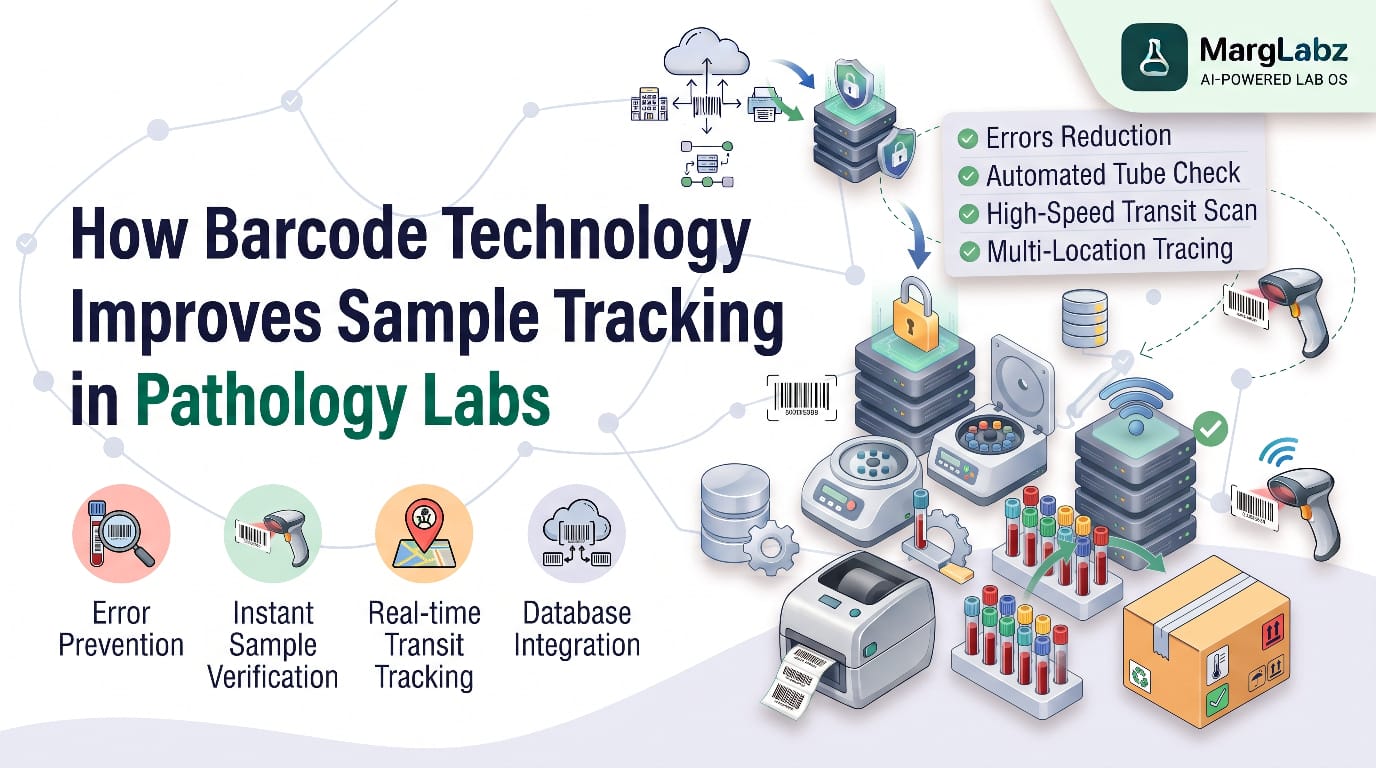
Every report a pathology lab produces relies upon the underlying assumption that the results produced relate directly to the individual who was tested. To ensure this assumption remains valid pathology labs utilize barcode-sample-tracking systems. A simple error with a mislabeled tube will produce incorrect results necessitate a re-draw of blood, cause undue stress to the patient, and require considerable time to determine what transpired. When working within an Indian diagnostic center (walk-in patients, home collection services, and sample deliveries via couriers) written labels and verbal hand-offs no longer provide sufficient scalability. Most pathology laboratories operate as hub-and-spoke networks i.e.
multiple collection centers, home phlebotomists and a central laboratory are all involved in processing the same samples. Therefore a poor hand-off by any party involved negatively impacts all others. This paper will address how barcode technology operates when it is effective when it is ineffective and how to implement barcode technology into the pathology laboratory without disrupting its normal operations.
What Is Barcode Technology in a Pathology Lab?
In addition to creating an individual identification for each sample using technology-based barcoding a labeled tube has a barcoded label attached to it and a scanner reads the barcoded label and translates the barcoded information into a unique ID. Laboratories can then use this unique ID as a search key in their software programs. Laboratories use either linear (1D) barcodes or compact 2D barcodes like QR or Data Matrix both of these types of barcodes can be placed on small tubes. Code 128 is a commonly used linear barcoding format for tube labels. Two dimensional (2D) barcodes have the ability to store more data than linear barcodes while taking up less space. No matter what type of barcoding you decide to employ make sure your scanners and analysis devices are capable of reading the barcode. Barcode labeling in medical laboratories is just one part of a larger system:
- The barcode is the identifier on the tube.
- The LIS contains the records of each patient, their orders, the status of those orders and results for the ID that the LIS uses.
- The instrument can retrieve or send information (data) and read the tube ID when both the instrument and its interface are compatible with the analyzer.
A barcode does not track anything by itself. A barcode becomes a laboratory sample tracking system when the data from the scan updates a common record.
How Barcode-Based Sample Tracking Works
A typical workflow:
- The registration of both the patient and the tests performed on that patient is completed as a single step. Once this information has been submitted a unique sample ID will be generated by the system.
- Label printing: as long as the record exists the label is printed based on the data contained within the record, therefore individuals do not have to write out identification numbers by hand.
- The phlebotomist identifies the patient takes a blood sample puts a label on the tube as they are doing so in view of the patient and then records the collection date/time and name of the person collecting the sample.
- Dispatch: When you scan the tubes into a manifest it creates the dispatch list for a collection center or home-collection batch.
- Receipt: The hub lab will use a barcode reader to verify the number of tubes received versus what is listed on the manifest. Any missing or extra tubes will be identified.
- Scanning is performed during processing and testing (at the sorting stage), centrifugation, and the analysis bench to update the status of the sample.
- Results will be attached to the Sample ID and the Report will link back to the Sample.
- Storage: location and retention are recorded for retrieval.
The labels will contain the following: The barcode (with the sample ID) a readable sample ID, patient's name, age, gender and collection date. This is what you have defined in your Standard Operating Procedure (SOP). Your barcode should only contain the sample ID and all other information can be retrieved from your Laboratory Information System (LIS). A shorter code will scan better and it will also expose less patient data in the event that a label is lost.
Key Benefits of Barcode Technology in Diagnostic Laboratories
- Fewer identification errors: IDs are generated not handwritten or retyped.
- Less repetitive entry: scanning replaces typing IDs at every bench.
- Real-time tracking: employees can tell if a sample has been collected is on the way has arrived at its destination or is being tested.
- The question "where is my sample?" can be answered with a system response instead of a telephone call.
- Audit trail: scans record who handled a sample where and when.
- Better prioritisation: urgent samples can be flagged and found quickly.
- Cleaner Rejection Data: The reasons for rejection on each sample ID may be viewed by center and/or by cause.
Common Sample Tracking Problems and How Barcodes Help
| Problem | Manual process | With barcode tracking |
|---|---|---|
| Mixed-up identity | Handwritten names, similar names confused | Unique ID printed from the registered record |
| Lost samples in transit | Paper lists, no check at receipt | Scanned manifest reconciled on arrival |
| Transcription errors | IDs retyped at register or analyzer | Tube scanned, ID not retyped |
| Invisible delays | Status known only by asking | Status updated at each scan |
| Weak records | Registers filled in afterwards | Time-stamped scan history |
A hypothetical example of how a hub laboratory would handle a missing sample is as follows: The hub laboratory receives a package via courier containing 42 samples (tubes) from three different collections sites. The lab technician then scans each tube using the manifest provided by each collection site. After scanning all 42 samples the system identifies that one tube listed as being sent from one of the collection sites was not received. Within minutes of this identification the hub lab calls the collection site that sent the missing tube. This phone call occurs prior to the patient calling the hub lab to inquire about the status of their results.
A second hypothetical scenario: Two individuals named Sunita Sharma with approximately the same age arrive at the facility in the same time frame. Handwritten labels can facilitate an exchange. However unique barcodes allow the system to differentiate between each person at every phase of the process, but the individual must be verified prior to obtaining a specimen.
How Barcode Technology Works with LIS Software
The LIS makes the scanner effective. After a tube is scanned the LIS displays the orders, shows the testing, and updates the tube's status. Often people confuse three things.
- Barcode technology: the label and scanner.
- LIS software: the database and workflow behind the ID.
- Analyzer integration: The way a laboratory device is connected to a computer system (e.g. HL7, ASTM) so that it can identify tubes make order requests and transmit data.
Scanning when receiving can identify a tube that was never ordered or has been previously received. The compatibility of scanning will vary depending upon the type of analyzer being used and the way in which it is interfaced with other devices therefore make sure to ask each manufacturer about this feature prior to making a purchase. In addition to asking about scanning capabilities you should also request a demonstration of the entire scanning process from the time the tube is registered until the time a report is generated and approved. If a particular analyzer cannot be interfaced with a computer system for automatic scanning manual benchtop scanning can be performed however manual entry of the scanned data into the computer system is required as well as a second review of the manually entered data.
MargLabz is an example of an AI-powered Lab OS for Diagnostic Laboratories. The company's website states that it provides 40+ modules including, Barcode Sample Tracking, Two Way Analyzer Interfacing, Patient and Sample Management, Report Management, NABL Ready Documentation Workflow, and ABDM Support. This connected software can provide reduced repeat entries and traceability however, results will depend on your processes.
Barcode Tracking Across Collection, Processing, Testing and Reporting
- Collection: Verification of identity labeling after drawing blood and scanning immediately following the draw are all part of the collection process. Additionally the scan captures a time stamp that is important when there is a delay between collection and analysis. For home collections, the scan can take place at the patient's entrance using mobile technology and then again when the sample is handed off.
- Processing: Scan samples when received, when they are transferred from one department to another and when an aliquot is created. All aliquots created must be labeled with their corresponding parent sample's identification (ID).
- Testing: Scan on the bench top or allow the instrument to scan the sample tube, then, check for and review any errors that have occurred during the testing process.
- Reporting: Results are linked to the Sample ID. Professional reporting will continue to be approved by qualified individuals, and all previous scans can be accessed in case an issue arises.
Challenges in Implementing Barcode Systems in Indian Labs
- Label quality: Thermal labels may become unreadable due to moisture from condensation or being placed in a refrigerator/freezer environment therefore, check if these conditions affect the labels you use.
- Tube sizes: small paediatric tubes need compact labels.
- Staff Practices: Scanning each time a handoff takes place appears to take longer than typing in data initially. Staff turnover requires that training occurs again.
- The collection centers that do not have good internet access will require a system that is able to function without being connected to the internet.
- Older analyzers: some may lack host communication.
- Outside samples: Referred samples that have been labeled with the barcode of another laboratory require a clear relabeling policy or a policy for connecting those samples to the correct lab.
- The cost of using printers, scanners, labels, and training should be evaluated relative to the cost of recollections.
Best Practices for Successful Barcode Implementation
- Map the current flow and decide which handoffs will be scanned.
- Pilot at one centre or department first.
- Standardise label layout and test scan reliability on real tubes.
- Label after collection in front of the patient.
- Write a fallback SOP for unreadable labels, with a recorded manual entry.
- Keep spare label rolls, ribbons and a backup scanner at every centre.
- The pathologist and quality manager should be involved when changes are made to the sample labeling or acceptance standard operating procedures (SOPs).
- Train by role and repeat for new staff.
- On a weekly basis review compliance with scan schedules. When there are samples that have been either not scanned or scanned later than they should be, these indicate when the habit of scanning has dropped off.
- Keep track of errors and rejections when identifying tracks both before and after, as well as adhere to your SOPs and any applicable quality standards.
Conclusion
In pathology laboratories, using barcode-based sample tracking is not simply using high-tech gadgets, rather, it is about being able to know, in real-time, exactly what position each sample occupies within the lab, and who has processed it. A barcode provides a unique identifier for each sample tube, the laboratory information system (LIS) interprets the meaning of that unique identifier, and the integration of analyzers allows for the physical location of the sample to be tracked on the workbench. When employees are adequately trained and there are clearly defined standard operating procedures (SOPs), the outcome will be sample management that relies less on human memory. Begin with a single process or "handoff" — for example, receiving samples from a central laboratory facility (hub) — and consistently scan those incoming samples for one month. After that time period, determine what improvements have occurred prior to implementing the same practice for all steps.
If you would like to experience firsthand how a connected laboratory system would manage your collection centers and analyzer operations, please contact MargLabz to schedule a free demonstration.