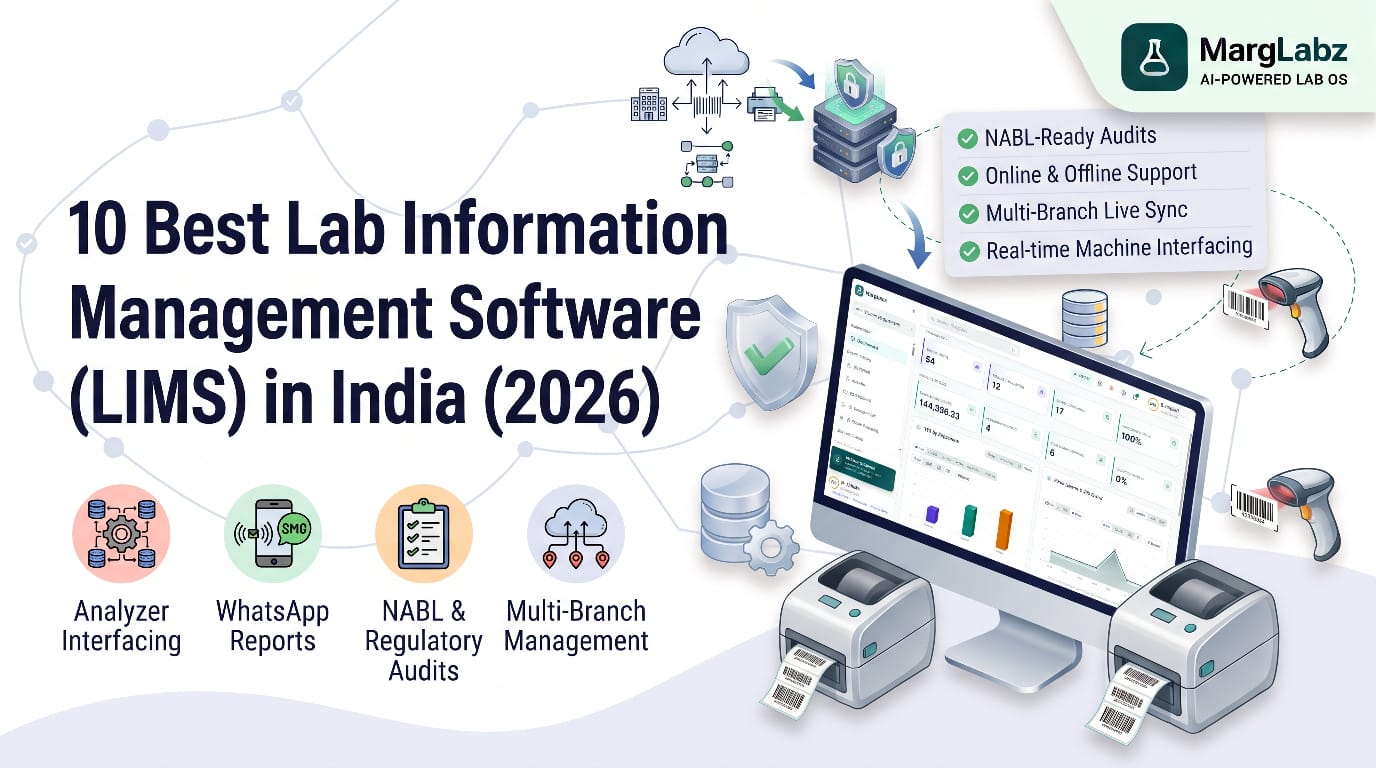
Indian Diagnostic Laboratories are rapidly transitioning from using Registers, Spreadsheets, and Desktop Billing Systems to using Integrated Digital Solutions. A laboratory today can manage Walk-In Patients, Home Collections, Collection Centers, Third Party Administrators (TPA) & Corporate Clients and Deliver Reports via WhatsApp on the Same Day. The Laboratory Information Management System (LIMS) or Laboratory Information System (LIS) chosen will determine how effectively the laboratory operates, including tracking of samples, accuracy of reports, connection of analyzers, speed of operation for employees, and overall control of multiple branches. This comparison document reviews 10 LIMS options to assist in selecting the most suitable LIMS software in India for your laboratory.
This is how the list was compiled: This is not an objective ranking. This list was compiled based on how relevant these products are to Indian diagnostics and pathology workflow, as well as the information available publicly from each manufacturer. MargLabz is placed first because this is MargLabz's blog, and all other entries are written as objectively as possible. Price and features change, therefore, please verify all details with the vendor prior to purchasing.
What Is a Laboratory Information Management System (LIMS)?
LIMS is an acronym for Laboratory Information Management System. LIMS is software that helps manage samples, testing, results, workflow and data within a lab. Specifically, LIMS is used to:
- How it works: Orders are entered into the system, a sample is prepared, testing is specified for each sample, results are documented, verified and then converted into reports.
- Sample lifecycle: tracking the collection, receipt, processing, testing, validation, reporting and storage or disposal of samples.
- Barcode tracking: The use of barcodes will tie every tube to a single patient and single order, which allows for viewing the location and status of each tube.
- Workflow automation: Worklists, auto-routing and rules reduce manual steps.
- Instrument Integration: Analyzers provide data to the software, and many can be provided with testing instructions.
- Data management: Patient, test and result data sit in one searchable place.
- Quality and audit trails: QC records and change logs show who did what and when.
Why Indian Diagnostic Laboratories Need Modern LIMS/LIS Software
- As demand for testing increases (due to seasonal changes, annual checkups, and partnerships with corporations), register limits are being exceeded.
- The danger of manual entry of data is that if you re-enter results, it can lead to incorrect decimal points and/or to errors with the identification of patients.
- The delays caused by waiting for manual validation and printing of reports are frustrating both patients and physicians.
- Analyzer integration: Different machines and protocols need careful interfacing.
- Multi-branch coordination: One view of samples for collection centers and a central laboratory.
- Patient communication: Patients expect reports on WhatsApp or email.
- Quality documentation: NABL preparation needs consistent, traceable records.
- The owner needs to know their daily revenue, turnaround time (TAT) and workload every single day with no phone call required.
10 Best Lab Information Management Software in India (2026)
- Ideal for: Individual laboratories providing testing services only, networks of laboratories with multiple locations, chains of franchised or collection-center laboratories, and B2B reference laboratories.
- Main characteristics: Described as an AI-powered operating system for labs with 35 modules across six distinct areas: central laboratory operations, laboratory automation, regulatory compliance/quality control, financial/business management, inventory/operational management, and digital health.
- Analyzer Integration: As stated on our website, we can integrate with any analyzer using an HL7/ASTM interface, and this will allow you to send results back and forth. You should check if your specific device is listed in the integration section of our website. Please note that device integration is a separate charge.
- Reporting: AI Smart Report with natural-sounding language, trends, multi-language support and delivery via WhatsApp, Email and SMS.
- Billing and Samples: Use of barcodes for sample tracking, home collections, GST billings, third party administrator (TPA) billings, corporate/franchise billings, and inventory/expiry tracking.
- The first two types are cloud and multi-location. These types of solutions can be used for either cloud-based deployment or multi-location deployment. In addition, there is also the option to use the basic plan, which will allow you to cover one location, and the enterprise plan, which will allow you to cover as many locations as you would like.
- Pricing: Public. Plans are available in three different categories, based upon your reporting requirements. The first category is the Basic Plan which provides up to 30 reports a day for ₹999/month.
- The second category is the Professional Plan which allows for unlimited reporting for ₹4,999/month. Additionally, there are custom Enterprise Plans available that will vary in price depending upon the size of your organization and the amount of reporting you require. All of these prices exclude GST. Analyser integration is a one-time fee of ₹9,999 per device plus an annual maintenance charge of 20%, as previously stated.
- Strengths: compliant workflows with NABL and ABDM/ABHA, AI reporting, clear pricing.
- Consider: The "Coming Soon" label is on some listed features, like the mobile application, and AI/CRM features are only available with the more expensive plans.
2.CrelioHealth
- Ideal For: Single Laboratories To Multi-Site Diagnostic Networks (Including Radiology).
- Key characteristics: A cloud-based, artificial intelligence (AI)-driven laboratory information management system (LIMS) based out of Pune, India that was established in 2013 as LiveHealth. According to the company, they have provided their product to over 2,500 laboratories across the globe, and are certified under HIPAA, ISO 27001, and SOC 2.
- Vendor Integration: The vendor lists more than 50 integrations including instrument, EMR/EHR system and middleware integrations.
- Reporting, billing, samples: Test panel configurations, reference range specifications, approval process flow and routing rules. Additionally, CrelioHealth provides separate inventory and PACS products.
- Cloud and multi-location: Cloud-native, with a Multi-Center plan.
- Pricing: Public, volume-based pricing is available on the Indian pricing page. Taxes will be added to your total price. Third party integrations are an optional feature for which you will have to pay more.
- Strengths: Mature platform with a broad integration list.
- Consider: Your plan will depend on how many tests you perform each year, and you may need to pay an additional fee for additional features like API access or HMIS integration.
3.DocPulse LIMS
- Ideal For: Standalone Diagnostic Centers, Clinics and Hospitals, particularly those who are looking for a LIMS (Laboratory Information Management System) as part of a larger hospital software solution.
- Main characteristics: cloud-based, paperless LIMS developed in Bengaluru, as part of the DocPulse HIMS family, it includes billing, sample collection, reporting, authorization, and data exchange.
- Analyzer integration: The vendor states that they can automatically retrieve results from the lab equipment. The compatible models are not mentioned anywhere on the pages I was able to view.
- Reporting: Formulas that are built-in will identify when data has exceeded its limits to help prevent reporting mistakes.
- The positioning of cloud-based and multi-location systems is ideal for healthcare organizations with numerous locations that require centralized laboratory management.
- Pricing: Not publicly disclosed (contact vendor).
- Strengths: Fits organisations that also need hospital software.
- Consider: Standalone pricing and analyzer compatibility need to be confirmed.
4.Healthray LIMS
- This is best suited for: Diagnostic Centers and Hospital Networks that combine Pathology and Radiology.
- Key features: Cloud based LIMS for pathology and radiology. Vendor states that they have a work-flow engine for SOPs, enterprise middle-ware connection, and sample tracking through to invoicing automation.
- Compliance claims: The vendor lists ABDM/ABHA integration, HIPAA and ISO 27001.
- Pricing: No information was available publicly on the vendors' websites I reviewed. However, some other sites list indicative starting prices for products/services similar to yours, please contact the vendor to verify.
- Strengths: Pathology plus radiology under one platform, with ABDM positioning.
- Consider: Multi-branch and analyzer details are not publicly verified.
5.DoraysLIS (DoraysLab)
- Ideal for: Small and mid-sized pathology and radiology labs.
- Key elements: Software for diagnostic management based on cloud-computing by Dorays Technologies (Jaipur, established in 2019). Dorays Technologies' product line includes Patient Engagement, LIMS, PACS and Inventory Management.
- Analyzer integration, billing, multi-branch: Not publicly verified.
- Older public plans have been listed on some reports, however, there are no current pricing figures that can be verified, therefore, it is recommended that you reach out to the manufacturer for this information.
- Strengths: The product is part of a single product line that offers both pathology and radiology products. The product line has been developed to serve as an entry point into each area.
- Consider: Confirm analyzer support and branch features.
6.MocDoc LIMS
- Ideal for: Standalone labs, hospital labs and diagnostic chains.
- Main features: Cloud based LIMS, was created in 2012. The main focus is that it can create custom reports, dashboards, patient portals, can be integrated with websites so that users may refer others to the site, and connects collection centers to laboratories.
- Vendor states that analyzers can be integrated through a two-way interface based on HL7 standards and there are many types of analyzers available. Still need to verify if particular models will work with this system.
- Pricing: Not publicly disclosed.
- Strengths: Strong public documentation on machine interfacing.
- The vendor has a significant focus on international markets, therefore, please find out about local support options in India.
7.Birlamedisoft PathoGold
- Best suited for: Desktop-based (traditional) small to advanced pathology laboratories.
- Main features: An existing Indian pathology LIS (Birlamedisoft, Pune). It has both "offline" desktop versions and "online" cloud-based versions, which are available as Express, Regular and Premium versions depending on the size of the lab.
- Reporting: Third party descriptions indicate that there are many different types of ready-made tests and reports (including both histopathology and cytology) available through the library.
- Analyzer integration and multi-branch: Not publicly verified.
- Pricing: Contact vendor.
- Strengths: Long market presence and flexible deployment.
- Consider: Check the current cloud, mobile and compliance capabilities.
8.LabSmart LIS
- Ideal for: Small and mid-sized pathology labs and diagnostic centres.
- Key Features: LabSmart Healthcare Technologies' cloud-based Pathology Laboratory Information System (LIS).
- LabSmart's pricing page includes features such as: patient registration, billing for pathology, outsourced testing, X-rays, USGs, CTs, MRIs, and ECGs, management of panels/packages, generation of business reports, downloads of QR code based reports, and delivery of reports via SMS, email, and/or WhatsApp. According to the manufacturer, LabSmart has been implemented in more than 1,500 laboratories.
- Pricing: Public. The Basic Pathology Plan costs ₹417 per month plus GST, which will be charged on an annual basis of ₹5,000 plus GST. Any usage over the fair-use limit will be charged as per usage.
- Strengths: Very transparent, low-cost entry.
- You may also want to consider: analyzer integration and multi-branch features are not currently publicly validated.
9.Qmarksoft Pathology Lab Software
- Ideal for: Small pathology labs wanting simple reporting and billing.
- The main characteristics of this product are as follows: It is a pathology lab reporting system which can be used both online and offline. Some third party sites state that it allows for patient registration, billing, various types of reporting options and the use of either barcodes or QR codes on reports.
- Analyzer integration and multi-branch: Not publicly verified.
- Pricing: Although third-party websites list a very affordable initial price point for this software, it has not yet been officially announced what the pricing structure will look like. Therefore, you should contact the software manufacturer directly to find out.
- Strengths: Affordable, straightforward.
- Consider: Check scale limits, analyzer support and cloud features.
10.Drlogy Lab
- Suitable for: Pathological Laboratories of Medium and Small Size that require Online Reservation and Patient Portal.
- Features: A cloud-based lab saas (Drlogy Technologies, Rajkot) which includes on-line test bookings, on-line referral tracking, on-line reporting, a patient portal and a mobile application. The third party listing also mentions barcode scanning and inventory.
- Analyzer integration and multi-branch: Not publicly verified.
- Pricing: Described by the vendor as customisable. Contact vendor.
- Strengths: Patient-facing features such as booking and portals.
- Consider: Verify analyzer support and branch controls.
Essential Features to Look for Before Choosing LIMS Software
- Patient/Sample Registration: Fast Data Entry, Repeated-Patient Searches, and Clear Order Recording.
- Barcode generation: Labels printed at registration, readable by your analyzers.
- Sample tracking: Status at every stage, including collection centres.
- Analyzer interfacing: One-way or two-way, with model-by-model confirmation.
- Validation queues, flags, templates and digital delivery for test and reporting.
- Quality control: QC records, rules, trends and corrective-action logs.
- Audit trails: Who changed or released what, and when.
- Billing & Inventory: Rate Lists, Discounts, TPA & Corporate Billing, Reagent Expiry Tracking.
- Cloud accessibility: Access across branches, backups and updates.
- Data security: Role-based access and secure storage, with a clear data policy.
- Multi-branch management: Central masters and branch-wise reports.
- Support and training: Onboarding, response times and local support.
How to Choose the Right LIMS Software for Your Laboratory
- Requirements for your laboratory include: test menu, daily volume of tests performed, types of analyzer used, number of branch locations and compliance requirements.
- Select software based on your business size. Laboratories that are small will require simplicity. Diagnostic centers that are medium-sized will require billing capabilities, referral capabilities, and interface capability with their laboratory instruments. Hospitals with laboratories will require links to electronic medical records (EMR) and hospital information management systems (HIMS). Multiple locations networks will require centralized master files and consolidated reporting.
- Insist on a real demo. Use your own scenarios and have your staff try it.
- Confirm the compatibility of your integration in writing. Identify the models of your analyzers and inquire about the type of interface used.
- Ask how we can help you implement your system. Your data migration, training and go live assistance is just as important as what features you have.
- Scalability of system. Is it possible to include additional users, locations and applications with no need to change systems?
- Total cost of ownership calculation. This includes subscription costs, setup fees, per device integrations, support, additional features and messaging expenses during a 3 year period.
- Talk to existing users of similar size.
Why MargLabz Is Worth Considering for Indian Diagnostic Laboratories
Your Laboratory. One smarter platform. MargLabz is an AI based laboratory software developed for use by Indian diagnostic labs. The software has 40+ modules across 6 categories, and therefore the focus of its value is not so much on the number of features but rather on how these features relate to one another.
- A single workflow: from registration through barcoded sample trackingto home collection to validation and signing off on reports, runs as a single process, therefore there are fewer steps at which mistakes may occur.
- Analyzer communication: The platform provides an HL7/ASTM interface that allows for two-way results transfers, as well as automatic validation using delta checks. Delta checks provide a means for automatic validation, as they compare current results to previous ones, and therefore only allow results that have changed to be transmitted. If you plan to rely upon this capability, then it is important to confirm what model(s) you are currently using.
- AI Smart Reports: The AI Smart Report is an add-on to the report signed by a pathologist that includes plain language explanations, trend graphs, and multiple languages, so that it may decrease the number of times people contact your front office for answers to their questions.
- Compliance-ready workflows: Quality control based on NABL/ISO 15189, audit trails, and documentation as well as ABDM/ABHA support will help you prepare for accreditation. These workflows are not designed to replace your current quality management system.
- Business application tools: Patient CRM and Website Builder available on Professional Plan. GST Billing, TPA, Corporate & Franchise Billing, Inventory Tracking with Expiration Dates, MIS Reporting.
- Patient lead pipeline: The Lead Engine has been designed to provide you with a pipeline of potential patient leads generated by over 250,000 chemists’ counters. It is an added benefit to assist you in achieving your growth objectives, however, its success will ultimately depend upon where you reside, and therefore cannot be guaranteed.
- Pricing is clear: Public plans begin at ₹999/month, and the price for analyzer integration will depend on how many devices you have.
Manage Your Laboratory. Simplify Your Operations. Support Your Growth. MargLabz suits labs looking for both laboratory workflow management and growth support within the same platform. This is a software program designed to support the work of professional staff, but not replace them.
Conclusion
The best LIMS software for you to use in India will be the one that is compatible with your current process, the size of your business, how well it integrates into your existing systems, what type of customer support you expect to receive and where you plan to take your business in the future. To find the right LIMS software for your business, start by identifying your requirements. Then select two or three potential LIMS software providers, perform product demonstrations using your own data and processes, and evaluate each provider based upon their total costs over a multi-year period.
Are you looking for a better way to operate your diagnostic laboratory? Find out more about MargLabz, then request a free demo to learn more about how MargLabz' AI Powered Laboratory Operating System (Lab OS) will help you with your day-to-day operations.