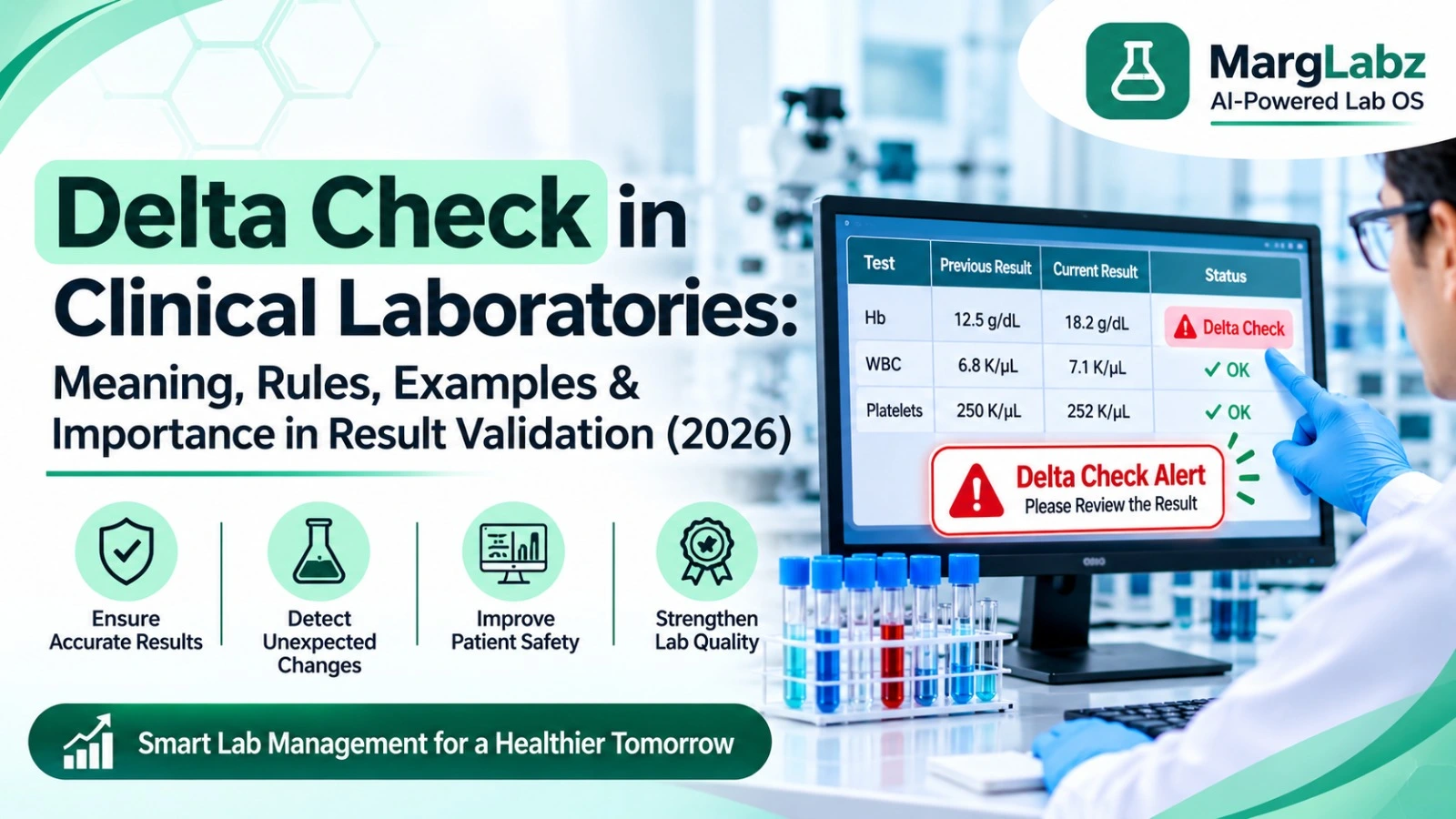
A delta check in laboratory testing is when a patient's most recent lab result is compared to their last lab result from the same test. When there is a greater change in the two results than what is allowed by the laboratory, the results are held back from release for further review rather than being released immediately. A flag could indicate that the sample was misidentified, there was a problem with the way the sample was handled, or there was some type of error during analysis. Additionally, a flag may indicate that the patient's condition has actually changed. The purpose of this guide is to provide an overview of how delta checking functions, how to compute a delta check, and what the limitations of delta checking are.
What Is Delta Check in Laboratory Testing?
A delta check is used to compare a patient's current laboratory result to his/her previous laboratory result and then report any significant changes that exceed limits established by each individual lab. "Delta" is used to define change. The CLSI guideline EP33 defines delta checks as comparing differences in consecutive results from the same patient.
An example would be a patient's hemoglobin is 12.8g/dL on Monday and then drops to 9.1g/dL on Wednesday. This will be flagged by the LIS. The technologist will determine if the patient has bled or received a transfusion, or if they have used the wrong blood collection tube. A flag is a reminder to review, it does not mean there has been an error.
Why Is Delta Check Important in Clinical Laboratories?
According to Randell and Yenice's review, most laboratory errors occur prior to analysis. Delta checks can help detect a portion of these errors.
- Unexpected changes that a busy reviewer could miss.
- Specimen identification errors, where a result belongs to a different patient.
- Contaminated samples, or other types of issues related to sample collection (for example, samples collected close to an intravenous line).
- Analytical or instrument problems, such as a drifting method.
- Real clinical change, such as bleeding, dialysis or treatment effects.
It also makes sure unusual results are looked at by a person before release.
How Does Delta Check Work in a Diagnostic Laboratory?
- Patient identification. The sample is matched to the patient and order.
- Current sample collection. The specimen is collected and labelled.
- Current test analysis. The analyser produces the result.
- The LIS will retrieve the previous result(s) of the same test on the same patient.
- Comparison. The current and previous values are compared.
- The rules for processing the lab's delta limits, methods, and timeframes apply.
- Flagging. A result beyond the limit is held with a delta flag.
- Review and investigation. A technologist or pathologist checks the cause.
- After a decision has been made about whether the results should be published as-is, modified, or re-run, the process is then documented.
Delta Check Calculation: Formula and Practical Examples
Two simple calculations are common:
Absolute difference = Current result − Previous result
Percentage difference = ((Current result − Previous result) / Previous result) × 100
Illustrative example 1 (Haemoglobin): Current 9.1 g/dL, previous 12.8 g/dL; absolute difference = 9.1 - 12.8 = -3.7 g/dL; percentage difference = (-3.7/12.8) x 100 = -28.9%.
Example 2: potassium. previous 4.2 mmol/L; current 6.1 mmol/L; absolute change = +1.9 mmol/L; percent change = (1.9/4.2) x 100 = +45.2%
These values are used to illustrate how to do the math. They are not to be taken as limitations. Each laboratory may utilize various ways to calculate data such as absolute changes, percentages changes, rates of changes, etc., as well as limits and timeframes for reporting. All of these methods will need to be verified at the local level.
Delta Check Rules and Reference Criteria
Delta limits are established by individual laboratories and vary depending upon the type of laboratory test performed. Multiple elements determine how these limits are established.
- Test-specific variation. Some analytes naturally vary more than others.
- Time frame. Changes occurring within two hours will be different than those occurring within two months. A national survey in China revealed a median maximum time frame of 5 days, however practices vary greatly.
- Biological Variability. The normal fluctuation of an individual's test results. CLSI EP33 emphasizes the importance of using valid estimates of biological variability for establishing reference intervals.
- Analytical variation. Method imprecision adds to the observed change.
- Patient Factor . Those undergoing dialysis, chemotherapy, transfusions, and those who are either neonates or in the Intensive Care Unit (ICU), can exhibit rapid changes.
Since no universal delta percentage exists laboratories need to establish their own rules, test them, and then periodically review them; the survey results provided here are an example of how widely practices differ.
Common Causes of Delta Check Failures
- Wrong patient identification or labelling.
- Specimen mix-ups between tubes or patients.
- Sample contamination, including IV fluid or anticoagulant carry-over.
- Haemolysis and other interferences.
- Other pre-analytical errors, such as delays in processing or wrong tubes.
- Analytical errors, such as calibration or reagent issues.
- Real physiological or pathological change.
- A change in method, instrument or reference system between results.
Delta Check vs Critical Value Reporting
They are different processes and should not be confused.
| Delta check | Critical value reporting | |
|---|---|---|
| Purpose | Detect unexpected change from the patient’s own history | Alert clinicians to potentially life-threatening results |
| Trigger | A change beyond the lab’s delta limit | A result beyond a defined critical limit |
| Role in workflow | Result validation and error detection before release | Urgent communication of a result |
| Patient safety relevance | Helps catch errors and real change | Enables immediate clinical action |
| Follow-up | Investigate, then release, repeat or correct | Notify the responsible clinician and document it |
A result can trigger a delta flag without being critical, and a critical result can pass a delta check if the patient’s previous value was also critical.
How Laboratories Investigate Delta Check Flags
- Verify patient details on the tube, request and LIS.
- Review historical results and the trend, not only the last value.
- Check sample quality for haemolysis, clots, volume and tube type.
- Review analyser flags and recent QC.
- Repeat the test if allowed by laboratory guidelines, or ask for another sample.
- Consult the responsible pathologist or authorised professional.
- Document the cause, action and outcome.
Role of LIS Software in Automated Delta Checking
A LIS will automatically pull a patient's prior results, compare them to the present result, evaluate the difference against preset rules and hold results that have been flagged for review. A LIS will also maintain a log of who reviewed each result, providing an audit trail. A LIS may also be integrated into an interface with an analyzer to provide verification of results when they are generated. A software flag is a notification. A software flag does not indicate whether the result is clinically significant or whether the final result is authorized.
Delta check can be found on MargLabz platform page as a "result that does not agree with the patient's history." In addition, there are critical value alerts, smart auto-validation rules, re-run handling with an audit trail and HL7/ASTM analyser interfacing. According to the site, AI will never authorize a clinical result on its own. When considering an LIS, inquire if delta limit(s) may be established for each test and time frame.
Benefits of Delta Checking for Diagnostic Laboratories
- More consistent review of unusual results.
- Earlier detection of possible specimen problems.
- A stronger quality assurance process.
- Less reliance on manual comparison with old reports.
- Better documentation of how flags were handled.
A Delta Check will not identify every error made in a lab. The Delta Check can fail to find an error when the error produces a believable result. Also, the Delta Check can produce false positives when there is actual clinical change.
Best Practices for Implementing Delta Checks in Diagnostic Labs
- Choose tests where delta checks add value, and define rules for each.
- Validate limits against your own data.
- Consider patient populations, such as ICU, dialysis and paediatric.
- Write review procedures and train staff.
- Document every investigation.
- Review performance (false alarms, missed errors) regularly.
- Keep quality records for audits and accreditation.
Future of Automated Delta Checking in Laboratory Medicine (2026)
Expect continuous improvements. LIS and middleware rule sets will include more historical data. Results from analyzer connections will be brought into the same review workflow. AI-based tools may assist in prioritizing the most important flags to review first. The human role in reviewing results, as well as the pathologist's responsibility for determining the end-result of a patient test, will continue to exist.
Conclusion
The delta check used in labs today has an easy to understand concept: compare today's lab results with the patient's past results and examine further if there are discrepancies. The best use of this process is when you have established, validated, test-specific rules and reviewers that are trained. If you want to find out how automated delta checking can be integrated into your workflow, explore MargLabz or Book a free demo.