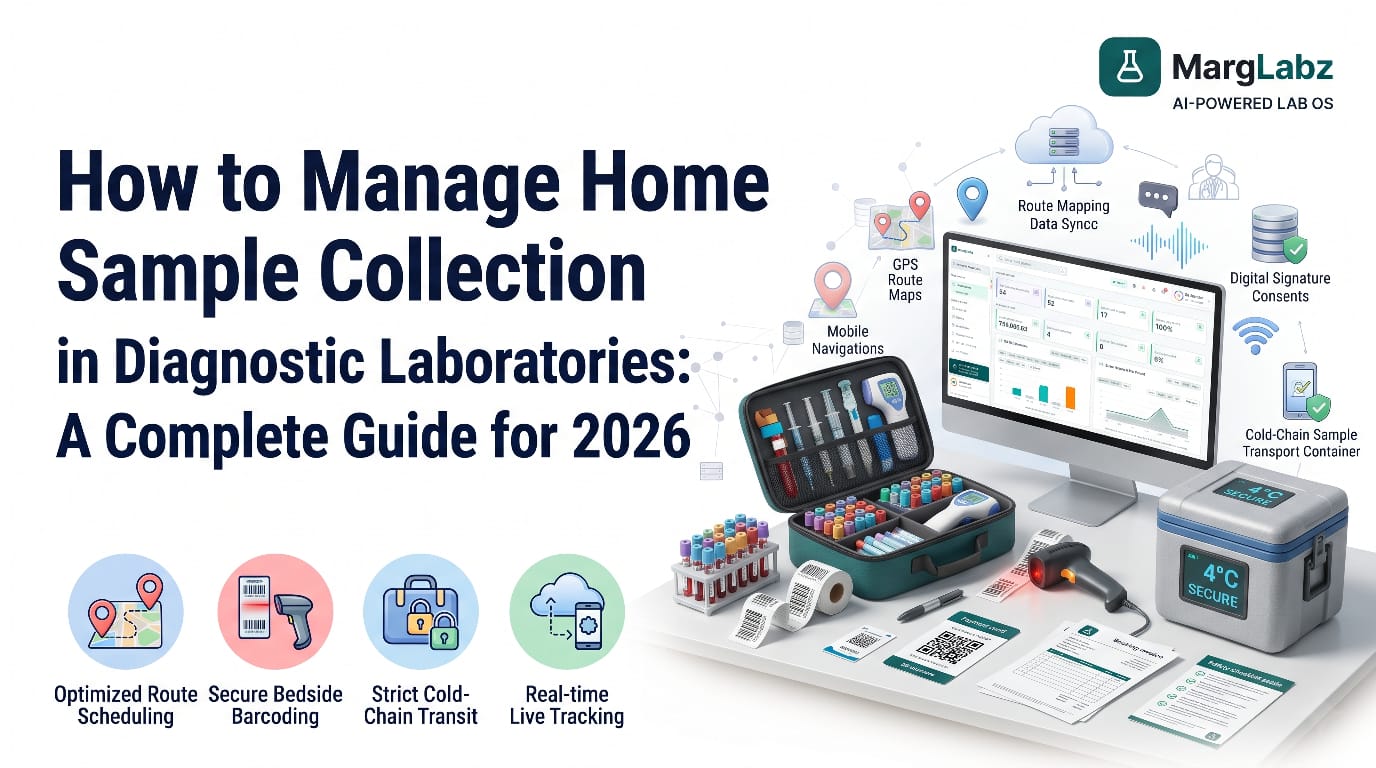
Why Home Sample Collection Is Becoming Important in 2026
Home sample collection management involves scheduling, assigning, collecting, transporting and tracking blood samples (as well as other types of samples) collected in the patient's home. The ultimate goal is to ensure that each sample arrives at the laboratory correctly identified undamaged and within the required time frame.
For many Indian diagnostic laboratories home sample collection has transitioned from being an option or supplemental service to a primary service offered by the laboratory. Many working adults, elderly individuals and patients who have difficulty leaving their homes due to physical limitations find home sample collection services preferable over visiting a physical location. However, a sample collected at the patient's front door transported throughout the city and delivered to the laboratory several hours later has numerous opportunities for error compared to a sample that was collected directly at the laboratory. This article will provide guidance on managing all aspects of the home sample collection process.
What Is Home Sample Collection in Diagnostic Laboratories?
Home based sample collection involves a professional phlebotomist visiting a patient's home/workplace to collect blood/other specimen samples and transport those samples back to the laboratory for testing. Quality standards apply to both types of collection (in-lab vs. home-based). The difference lies within the level of control the laboratory is required to monitor identification, hygiene, timing, temperature and documentation when collecting samples remotely.
How Does the Home Sample Collection Process Work?
The booking is made by the patient. A phlebotomist is assigned to collect and label the blood samples. The phlebotomist then transports the samples to the laboratory where they are received and registered. Tests are conducted on the sample(s) and a report is generated. Below we describe what happens at each step in more detail.
Step-by-Step Guide to Managing Home Sample Collection
1.Patient booking and appointment scheduling
Accepting bookings through the phone, WhatsApp, on-line, or app. Gather the following: first name, last name, age, gender, phone number, street address with landmark, laboratory tests, and booking time. Limit the availability of slots based on how many phlebotomists are available to work in that specific area.
2.Test selection and booking confirmation
Confirm that you are having the correct tests performed, the cost of those tests, and when you can expect to receive your results. Let the patient know what to prepare for each test (i.e. fast if required), let them know who will be drawing their blood and give them their scheduled time slot.
3.Assigning trained phlebotomists
Match the number of visits to each location (area) during specific times (slots) based on your team's skills, i.e., child (paediatric) or older person (elderly) blood draws. Provide each phlebotomist with a list of their assigned visits, including patient identification, testing requested and types of tubes required.
4.Patient identification and preparation
The patient's name must be confirmed prior to collection of the sample. In addition, there must be a second identifier present at the time of collection. Your laboratory has specific requirements for preparation of the sample. It is important to review these prior to beginning the procedure. You will also need to inform the patient about the procedure that they are undergoing. Consent should then be documented per the policies of your laboratory.
5.Correct sample collection procedures
Follow your SOP (Standard Operating Procedure): wash hands, use gloves, choose the right type of blood collection tube and make sure you follow the correct order of drawing blood make sure there is enough blood collected gently mix if necessary dispose of sharp items in a puncture-resistant container.
6.Barcode labelling and sample identification
When you finish drawing blood from the patient label the tube in front of them using a barcode that is tied to their scheduled appointment. If you are able to use your equipment to scan the tube at the door then do so.
7.Safe sample transportation
Keep tubes vertical in a sealed container that won't leak, use cold packs or insulated containers if required by the test and write down the date/time of collection. Deliver the samples to the lab within the time specified by the lab.
8.Sample receiving and registration
The next step is to scan each tube with the visiting list. Verify each tube's identification number, volume and condition. Based on those factors either accept or reject the tube according to your guidelines. Finally record the time the tube was received.
9.Processing, testing and report generation
The process of analyzing the results from your home-based sample follows the exact same procedures as those followed when you submit your sample to our laboratory. The accuracy and validity of the final result will be confirmed and authorized by certified experts.
10.Patient notification and report delivery
Share with us what you believe will be the expected date of delivery for the results/report then let the patient know that their results/report are available for download via WhatsApp, Email, or the Patient Portal.
Major Challenges in Managing Home Sample Collection
| Challenge | What goes wrong | Practical fix |
|---|---|---|
| Scheduling clashes | Too many visits in one slot or area | Capacity-based slots by area |
| Identification errors | Pre-labelled tubes, similar names | Label after collection, in front of the patient |
| Delay in transit | Samples wait for batch pickup | Pickup rules and lab-defined time limits |
| Missing records | Collection time not noted | Record or scan at the visit |
| Rejections | Haemolysis, low volume | Training and feedback by phlebotomist |
How to Manage Phlebotomists and Home Collection Teams
- Train & Assess: Check technique patient handling and SOP knowledge on day one and then throughout your time here.
- Standardize kits: a checklist that includes tubes, labels, gloves, sanitizer, cool packs, and a sharp container.
- Plan by area: cluster visits to reduce travel and late arrivals.
- Use daily visits list daily reconciliation (end of day) and have a designated supervisor for escalation purposes.
- Feedback: provide each individual's rejection and recollection data as learning opportunities not as punishment.
Importance of Barcode-Based Sample Tracking
Nobody else at home will be able to check a hand-written label therefore a barcode that is tied to a booking is the most effective way to prevent errors. A barcode provides the laboratory with a sequence of events, collection, transportation, receipt. Our article on using barcodes to track samples in pathology laboratories describes the process of sample tracking and some of the disadvantages of using barcodes.
Sample Transportation, Temperature Control and Sample Integrity
The temperature and duration of testing will be based on the specific test being performed and the type of sample. Therefore there are no general rules that apply to all samples. Always refer to the manufacturer's directions and your own validated standard operating procedures (SOPs).
- Define handling conditions per test and put them on the visit list.
- Protect samples from heat and direct sunlight, especially in summer vehicles.
- Keep tubes upright and avoid shaking.
- Record collection and receipt times and note the condition on arrival.
- Reject or recollect per your criteria and document the reason.
For biosafety, wear gloves, wash your hands, and use puncture-resistant sharps disposal containers. Also, discard all waste according to the relevant biomedical waste regulations. If your laboratory is currently accredited or if you plan to become accredited find out what the ISO 15189 standard and your accreditation organization say about off-site collections.
How Laboratory Management Software Simplifies Home Collection
A connected system takes a reservation to be a registration prints out barcodes for each item in the system, monitors where the items are (from the time they were ordered until they arrive at their destination) and connects the results back to the samples. Compared to calling writing things down on paper and using spreadsheets this reduces having to type the same information over again and helps you see if there are any problems with the process. The connected system will help your team and support your Standard Operating Procedures (SOPs) but will not replace either of those.
Essential Features to Look for in Home Collection Management Software
- Online and phone booking with slot control
- Patient registration linked to billing
- Phlebotomist assignment and visit lists
- Booking-linked barcode label printing
- Sample status tracking from collection to report
- Rejection and recollection records
- WhatsApp, SMS and email notifications and report delivery
- Reports by branch, phlebotomist and turnaround time
- Role-based access and data protection
Common Mistakes Diagnostic Labs Should Avoid
- Labelling tubes before collection
- Giving every sample the same transport conditions
- Skipping preparation instructions
- Not recording collection time
- Overbooking slots
- Ignoring rejection data by phlebotomist
- Treating home collection as a side task without its own SOP
Best Practices to Improve Home Sample Collection Operations
- Write a separate home-collection SOP and review it regularly.
- Use confirmations and reminders to cut no-shows.
- Pilot software or process changes in one area first.
- Review turnaround, rejection and late-visit data monthly.
How MargLabz Supports Modern Diagnostic Laboratory Management
MargLabz is an artificial intelligence (AI) powered lab operating system for use in diagnostic laboratories. According to their site, they offer a number of services such as registration through reporting, barcoded sample tracking appointments scheduled via software, patient registration, printing barcodes for samples home collection and routing phlebotomists, and delivering reports and invoices via email, WhatsApp, or SMS. Higher-level subscription plans also include a CRM system for patients, AI-based voice bookings, AI receptionist capabilities, and the enterprise plan includes support for an unlimited number of locations/collection centers. On their pricing page, there is mention of a free mobile application that will be available therefore when you schedule a demo with MargLabz ask specifically about the current functionality of the mobile application for use by phlebotomists. To book your free demo click here.
Future of Home Sample Collection in India
More bookings are expected to occur via messaging and mobile applications, there will be greater integration with digital medical records (such as ABDM) and there will be more focus on ensuring that documented samples maintain their integrity.
Conclusion
Good home sample collection management comes down to a few habits: accurate booking, trained phlebotomists, labelling in front of the patient, controlled transport and complete records. Software helps hold these together, especially across branches, but the SOPs and people do the real work. Start by writing a home-collection SOP, then measure delays and rejections.