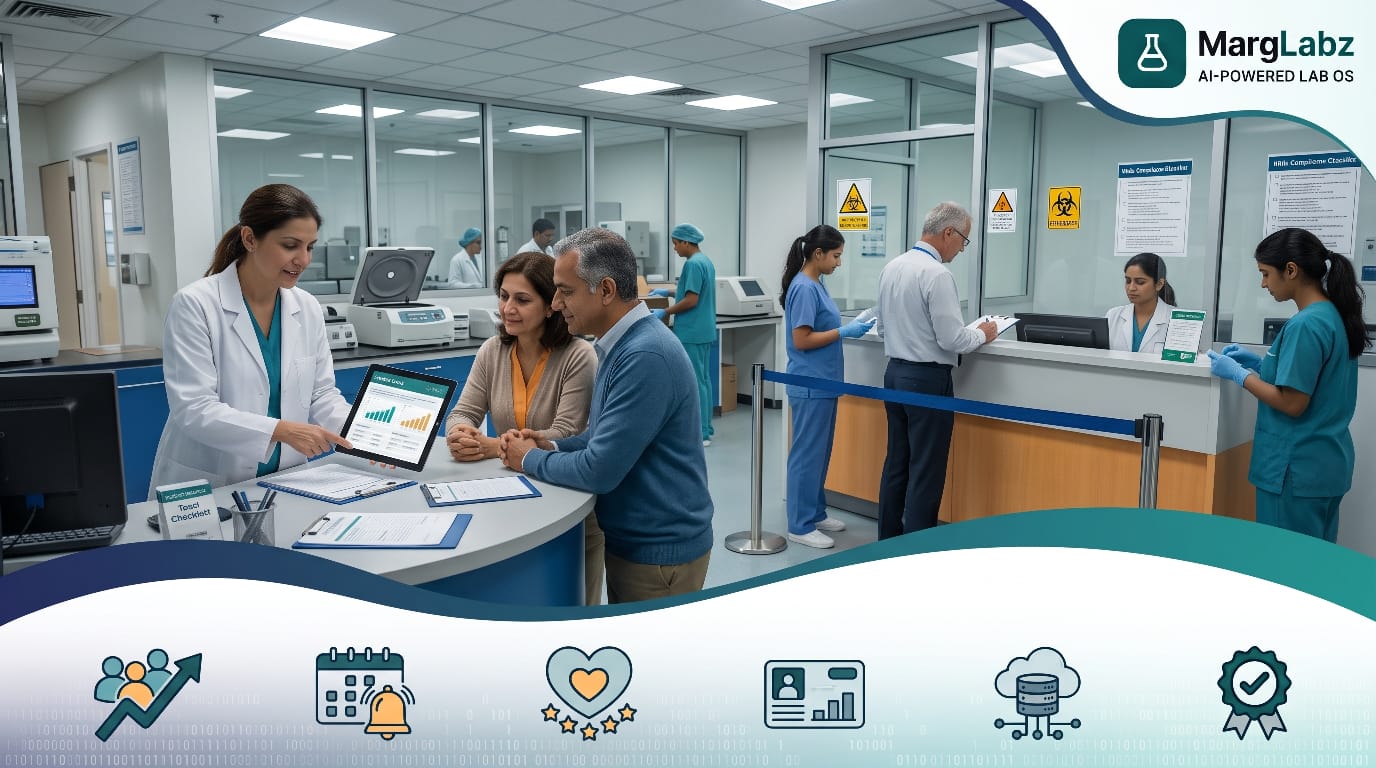
The number of laboratory facilities available within a community is often highly variable. Most of the laboratories in a given community perform similar testing procedures, often with minor differences in pricing. As a result, what are the primary reasons for variations in the patient volumes of these laboratories?
The machines are rarely the answer. Your patients don't care whether you use the top of the line analyzer. They only care about how long it took for them to get through the process, how quickly they received their test results, and whether or not they believe those results were accurate. Those are the factors that will help decide if they will return to your site.
The purpose of this guide is to help owners of diagnostic/pathology laboratories, as well as laboratory managers and/or directors of operations at single and/or multiple locations of laboratories. This guide will provide both practical and ethical ways to attract additional patients, while at the same time maintaining the relationship with existing patients.
Why Retention Matters as Much as Acquisition
Most laboratory businesses are focused on bringing in new customers with low pricing, billboards, and health fairs. However, a single-time customer can be very expensive. In contrast, a long-term customer who comes back to your facility every few months for years will provide you with the foundation of financial success.
Retained patients also:
- Refer family and friends, which is the cheapest form of growth
- Buy health packages and regular follow-up tests
- Cost less to serve, because they already know your process
- Leave positive reviews that attract new patients
- Provide longitudinal data that improves care and trends
Acquisition and retention should be viewed as a single continuous cycle. Find potential new customers (acquisition); offer a high-quality product/service; follow-up with customers once they've experienced the product/service (retention); ask for referrals from your satisfied customers.
What Patients Really Look For in a Lab
When patients or their families choose a lab, a few things matter most:
- Trust and credibility: Accreditation, qualified staff, and a good reputation
- Doctor recommendation: Many patients simply go where their doctor sends them
- Convenience: Location, timings, home collection, easy booking
- Speed: Short waiting time and reports delivered when promised
- Accuracy: Confidence that results are correct
- Clear communication: Understanding preparation, price, and results
- Fair pricing: Transparent rates with no surprises at billing
- Courtesy: Respectful, patient, and professional behaviour
Every strategy below connects to one or more of these.
Part 1: Attracting More Patients
1.Build trust visibly
Trust is your strongest marketing asset. Make it visible:
- You should post information about whether or not your lab is accredited (e.g., NABL) as well as the names of pathologists who have met the qualifications to practice in your lab, both on your lab's website and on site where your lab is located.
- Share your testing standards and quality practices in simple language
- Keep the centre clean, organised, and well-staffed
- Collect and display genuine patient reviews
Our Guide to Lab Software, and how it helps you manage your quality activities under NABL (National Accreditation Board for Testing and Calibration Laboratories) quality management guidelines, shows you how your day-to-day quality control efforts will help support your accreditation application.
2.Make your online presence easy to find
Most patients now search online before choosing a lab.
- Claim your Google Business Profile, providing a correct address (physical location), your business hours, phone number, a list of what you offer, and some pictures.
- Create and maintain a simple website with details about testing choices, offered services, pricing options (when applicable), service options for collecting samples at home, and ways to book appointments.
- Create easy-to-understand content on health, preparation, and testing in plain language that has been checked for accuracy.
- Encourage reviews from satisfied patients and reply to every review politely
- Stay consistent with name, address, and phone number across all listings
3.Build relationships with referring doctors
Doctors remain the biggest source of patients for most diagnostic labs.
- Deliver accurate and timely reports consistently
- Offer easy access to reports and patient history through digital delivery
- Provide clear report formats with flags and trends
- Respond quickly to doctor queries
- The user has requested that I maintain professional standards for communication, ethics, referral practices, and incentive practices as prescribed by law.
Doctors refer to labs they trust and that make their own work easier.
4.Offer convenient access
Convenience wins patients who are busy, elderly, or unwell.
- Online booking with time slots
- Home sample collection with clear time windows
- Extended hours or early morning slots for fasting tests
- Collection centres in accessible locations
- Corporate and society tie-ups for regular testing
- Multiple payment options such as cash, card, and UPI
5.Create thoughtful health packages
Well-designed packages attract patients looking for regular checkups.
- Based on what is most common among your patients (e.g., assessing the symptoms associated with diabetes;
- evaluating whether there may be an issue with the thyroid gland; evaluating the amount of cholesterol in someone's body through a blood test called a lipid panel; and having a regular yearly check-up), create a package.
- Price them transparently
- Explain what each test is for, in plain words
- Avoid inflating packages with unnecessary tests
6.Use community and local outreach
- Conduct Health Camps at Schools, Offices, and Residential Societies; Obtain Consent, Maintain Privacy_
- Partner with local clinics, pharmacies, and wellness centres
- Provide both general health information, such as ways to avoid contracting colds and flu, and seasonal health information, like getting tested for monsoon fever, or taking care of your health during the cold winter months.
- Support awareness days with accurate, educational content
7.Market ethically and accurately
Health marketing carries special responsibility.
- The use of "cures," "guaranteed identification," and/or "complete" screening should not be exaggerated.
- Do not use fear to sell tests
- Show real prices and conditions for offers
- Follow applicable advertising rules for healthcare services
- Respect patient privacy in testimonials and photos
The most effective manner of marketing your product in an ethical manner is by building long-term customer relationships based upon mutual trust.
Part 2: Increasing Patient Retention
To get a patient into your office for the first time is easy; to keep that patient coming back is what makes the difference. Retention is created through experience, not deals.
1.Keep waiting times short
The single greatest issue for patients is wait time. If you wish to reduce the amount of time patients have to wait, there are several methods you may employ, such as setting up appointments for patients, implementing a token system, utilizing fast-tracking registration procedures and staffing your collection site with sufficient staff when patient volume is highest. This article provides guidance on setting up the collection site in your clinic as an element of our phlebotomy workflow management in diagnostic center guide.
2.Make collection comfortable and safe
In order for your phlebotomy staff to be successful in providing the best service to your patients, they should be well-trained on both the technical parts of the job and how to talk to patients. Your phlebotomists are going to be able to remember if a patient has a child who was scared of needles, and therefore make sure that patient gets an easy blood draw. If a patient has had trouble getting a vein drawn before, your phlebotomists will remember that, and help the patient through the process.
3.Deliver reports on time and as promised
The most significant factor that causes a patient to switch to a different laboratory is when reports are missed. If you want to retain your patients, you must have realistic turnaround times and track how long it takes for a report to be completed. Additionally, when you know that you will be late with a report, let the patient know in advance so they do not worry about when they will receive their results. There are several ways in which a diagnostic laboratory can decrease the amount of time it takes to complete a report. Some of these techniques include having a system to track TAT; setting achievable goals; communicating clearly with patients regarding their expectations; and providing educational materials to patients.
4.Make reports easy to understand
A patient who reads a clean, easily-read report that is formatted well and is accessible on a smartphone will experience less anxiety. Patients who are given access to reference ranges, trend charts, and simple explanations of what their lab test results mean will have fewer concerns and will need to contact the provider less frequently. The "AI Smart Reports" article includes more information regarding how AI smart reports can help patients understand their test results.
5.Keep billing simple and transparent
When customers get to the cash register, they find out how much money they have to pay. This ruins customer trust. Your price information should be available before customers come in; you need to let them know what is included in each service package; you need to provide discounts equally to all customers; and your receipts must be easy to read. If you want to know more about how to develop an accurate and consistent billing process with diagnostic laboratory billing software, please refer to our full-length guide to diagnostic lab billing software.
6.Follow up and remind
Patients need to be tested on an ongoing basis (e.g., those who have diabetes; people with histories of thyroid disorders; people who take prescription drugs over long-term periods; and people who are examined yearly).
- Send reminders for repeat tests, with their consent
- Share health tips relevant to their last visit without giving medical advice
- Offer easy rebooking by phone, WhatsApp, or online
- Send a thank-you message or short feedback request after each visit
7.Listen and fix problems quickly
- An effective way to provide feedback is through methods such as QR Codes, WhatsApp, and Short Forms.
- Respond fast to complaints, and fix errors without defensiveness
- Track patterns in feedback and act on them
- Close the loop by telling patients what changed
- A customer who files a complaint and receives quality service will have higher levels of loyalty than a customer who has never filed a complaint.
8.Protect patient privacy
Lab data is extremely private. To protect the privacy of patient information, you should utilize a role-based access system to limit who has access to laboratory data. Laboratory data should also be kept secure, such as by restricting access to the laboratory facility itself. Patients must give their permission prior to being contacted about laboratory results. Finally, when sending laboratory results or other related information via WhatsApp, please refrain from posting laboratory results or other related information in public WhatsApp groups. Please adhere to all applicable data protection laws. Trust develops when people feel that their personal information is protected.
9.Reward loyalty in simple ways
- Family health plans and repeat-visit benefits
- Priority slots for senior citizens and regular patients
- Free or discounted follow-up tests where clinically appropriate
- Recognition for long-term patients
The rewards for being a patient at your practice should be genuine, and they should have limits. Patients will continue to come back to your practice because they appreciate the quality of health care that you provide, and not merely because of the discounts that you give them on their treatments.
How Lab Software Helps You Attract and Retain Patients
Good patient experiences depend on how well a laboratory functions, and that depends on having good systems in place. Today’s Modern Laboratory Information Systems and Laboratory Management Software are working behind the scenes to help support most of the laboratory functions we have already talked about.
- Online booking and scheduling reduce waiting time
- Fast registration with saved patient history makes repeat visits easier
- Barcode-based sample tracking reduces errors
- Analyzer integration and validation workflows shorten TAT
- Digital report delivery by email or WhatsApp saves patients a trip
- Patient history and trend views support doctors and patients
- Billing controls keep pricing consistent and transparent
- Reminder and communication tools support follow-ups
- The dashboards will show you: • How many individuals have come into contact with your site • If those individuals have come back to your site • Who referred those individuals to your site • What percentage of each test/package ordered has been used by each individual.
Modern pathology laboratory software and modern laboratory software will allow for connection of those two processes to the actual laboratory; therefore, what you promise at the reception desk will be reflected in the final report. In terms of network operations, diagnostic center management software and a central laboratory management system will enable consistent standards throughout each branch and each collection site. This is important since patients judge your organization based upon their worst experience, not your average experience.
Where MargLabz Fits
MargLabz is developing a Cloud-Based AI-Powered Operating System for Laboratories and Pathology Collection Centers as well as for rapidly expanding networks. MargLabz is offering several different modules that provide various types of functionality such as Patient Registration, Scheduling, Billing, Accessioning, Validation, Quality Control and Reporting. MargLabz also provides a voice activated booking option, an AI based reception desk, integration with ABDM/ABHA, and a comprehensive Dashboard providing users with access to data regarding tests ordered, TAT (Turnaround Time), and revenue generated through each type of billing used. MargLabz charges ₹999/month + GST. It would be beneficial to request a demo of the software from MargLabz and assess how effectively the software would integrate into your existing patient flow prior to making a purchase decision.
Metrics to Track
| Area | Example indicators |
|---|---|
| Acquisition | New patients per month, source (doctor, online, walk-in, camp) |
| Retention | Repeat patient rate, return interval, package renewals |
| Experience | Waiting time, TAT within target, complaints, review ratings |
| Referrals | Patients referred by doctors and other patients |
| Revenue | Revenue per patient, package uptake, outstanding dues |
| Quality | Rejection rate, report corrections |
Review monthly and ask one simple question: are more patients coming back?
Common Mistakes to Avoid
- Relying only on discounts to attract patients
- Using fear or exaggerated claims in advertising
- Ignoring online reviews and complaints
- Focusing on acquisition and neglecting follow-up
- Making promises about report timing that the lab cannot meet
- Inconsistent service and pricing across branches
- Sharing patient information carelessly
- Publishing health content without professional review
- Not tracking where patients come from or whether they return
A Simple 60-Day Action Plan
Day 1 to Day 15: update your Google Business listing, review the customer's experience at your clinic, and identify the top three most common complaints.
Days 16 to 30: Reduce the length of customer wait times, create easy to understand bills, and provide timely reporting. Create acceptable turnaround times (TATs).
Days 31 to 45: Begin the patient online reservation process. Provide the opportunity to patients to make reservations for the collection at their homes. Create a simple method for patients to provide you with feedback. Meet with each of the doctors that refer most of your patients.
You should begin to track how many patients have undergone multiple tests. You will need to develop two testing kits and ask your pathologist to evaluate both. You will also need to establish a system for gathering and reviewing test results. Additionally, you will want to remind patients who return for treatment during the period of day 46-60 that they may require additional testing.
Final Thoughts
The patient had a pleasant visit to the lab, and therefore plans on returning. The staff at the lab was very nice, the results were produced quickly, and the patient had confidence that the results would be accurate. All parts of your business from the front desk, to the instrument used for testing, to the final report -- are all a part of your marketing efforts.
Provide a reliable, user-friendly service with quick turnaround time; clearly communicate with customers; accurately promote your company; and utilize technology to provide all customers at every location with a consistent experience. These steps will help you expand your company and develop customer loyalty.
If you are looking for an example of how a connected laboratory system can help support the patient experience, look no further than MargLabz. MargLabz has developed laboratory management software that was built from the ground up for use in diagnostic and pathology labs, collection centers, and multi-location networks. Their pricing starts at ₹999/month (plus GST).