The collection center sends a sample to the central laboratory. It arrives there at approximately 11:00 AM. One label on the sample indicates something else than what is written in the registration log. An analysis result is entered manually into the system. Finally, a report is sent to the patient, but only after they have contacted the central laboratory twice. Although none of these steps are difficult, the problem lies in the fact that each of them occurs in a separate location.
This guide explains the different types, technologies, and processes used for laboratory integration in India. Additionally, this guide will provide a list of things to consider when deciding to purchase a laboratory integration system. Laboratory integration allows the movement of information between various areas of a healthcare facility. These include: patient records, blood samples, test results, billing, and reporting. All of these areas are linked together through laboratory integration so that no data needs to be manually entered twice.
What Is Laboratory Integration?
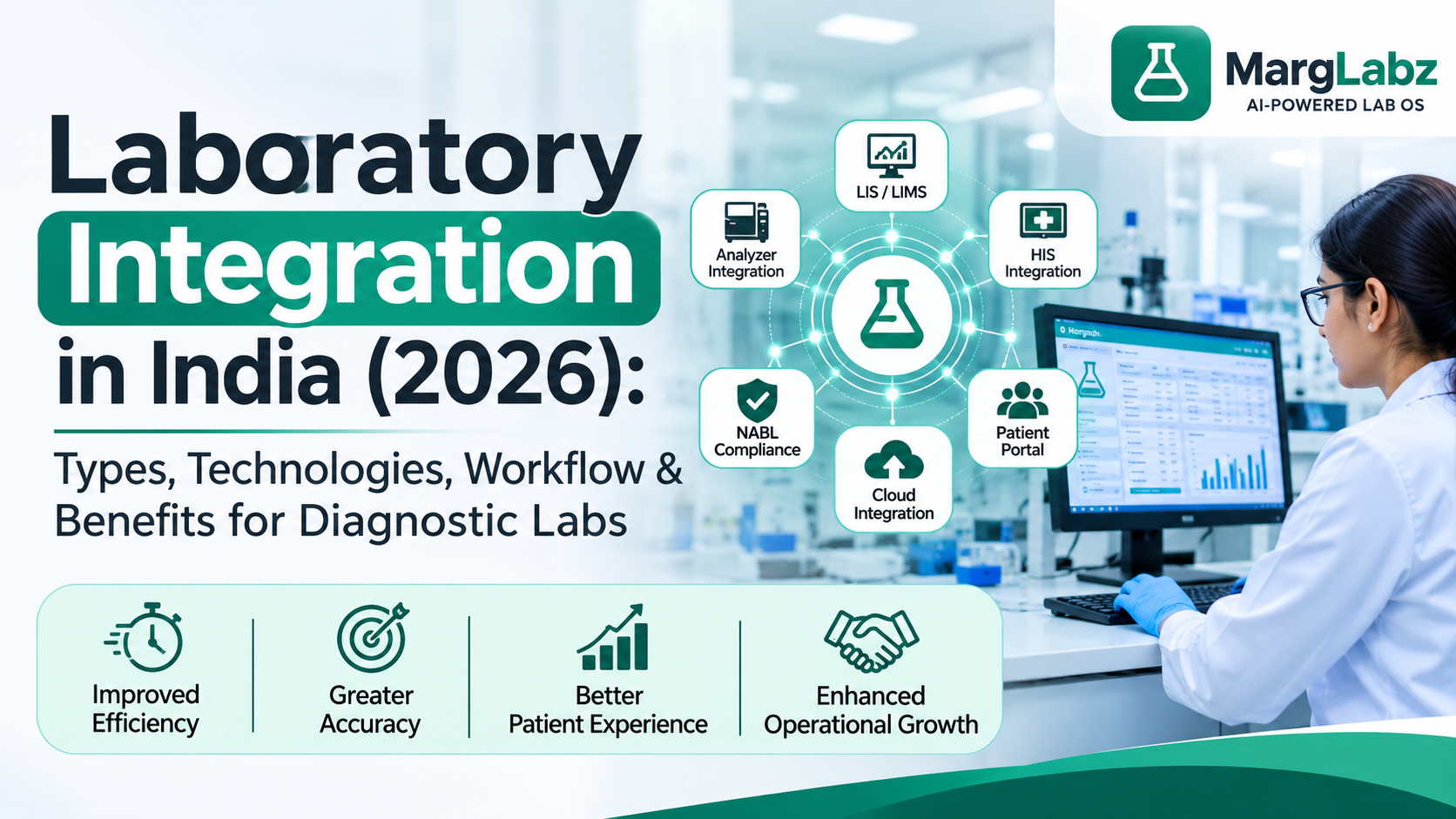
The laboratory integration is an electronic connection of all of your laboratories systems, which allows you to enter data only once and have it available everywhere you need it. Usually, the systems that are connected include the Laboratory Information System (LIS), the Analysers, the Billing System, the Hospital Information System (HIS), and the Patient Messaging System. All of these systems use agreed-upon standards for transferring data, which we refer to as Protocols.
For example, when a patient registers at a collection center, their barcode label is printed at that location. After the central laboratory performs the requested tests on the specimen, the approved test result will be sent to both the patient and the referring physician without any additional entry of information.
Why Is Laboratory Integration Important for Modern Diagnostic Labs?
Manual hand-offs cause predictable problems:
- names and results retyped wrongly
- samples that cannot be traced between collection and testing
- staff phoning branches for status
- reports waiting while someone keys in values
- bills that do not match the tests run
Because poor collection, bad master data and missed checks still require trained people and processes, integration will reduce but not eliminate these problems.
Different Types of Laboratory Integration
LIS Integration. The center of the system is the LIS. It contains registration information, ordered tests, results and reports from tests, and is connected to other systems.
LIMS integration. A LIMS controls samples and batches, primarily in research, pharmaceutical and industrial laboratories. Many companies refer to their products as either "LIS" or "LIMS," therefore, evaluate each product based upon its functionality.
Analyzer integration. Results are sent back from the instrument to the LIS after being analyzed.
HIS integration. The registration, orders and reports of a hospital will sync with its lab this is typically done using HL7 messages or APIs.
Integration of Billing and Payments. Test orders will flow to an invoice which includes GST handling, UPI/Payment Gateway integrations, and accounting systems.
The pathologist sends a final report or update after he/she approves it. This is sent through WhatsApp, SMS or Email.
How Laboratory Integration Works: Step-by-Step Workflow
- Patient Registration. Patient demographic data (and ABHA, if applicable) is entered into the laboratory information system (LIS) only one time.
- Test booking. Tests and packages are selected and the invoice is generated.
- Barcode generation. A unique sample ID and labels are produced.
- Sample collection and identification. Labeling occurs when samples are collected, and then these labels are read when the samples arrive at the laboratory.
- Instrument communications. After scanning the bar code, the instrument obtains the test(s) to be performed from the Laboratory Information System (LIS).
- Result transmission. Results return to the LIS with units and flags.
- Technical validation. Results are evaluated against reference ranges, quality control, and rules; and then approved by the pathologist.
- Report generation. Approved results fill the report template.
- Patient notification. The report is delivered by WhatsApp, SMS, email or portal.
Role of HL7 and ASTM Protocols in Lab Integration
HL7 (Health Level Seven) is a group of standards that provide a means to share health-related information among different computer-based systems. HL7 v2 messages are commonly used to transmit orders and results from a laboratory information system (LIS) to other types of systems, including hospital information systems (HIS).
ASTM. in this context, refers to the communication standard between instruments and LIS systems, known as ASTM E1381 and E1394. The Clinical and Laboratory Standards Institute (CLSI) has taken on responsibility for the standards, which are now called LIS01 and LIS02. The standards describe how an analyzer and LIS exchange requests and results; they initially used serial connections but have transitioned to TCP/IP. Because vendors implement these standards differently, each type of analyzer requires its own interface validation. Additionally, many newer instruments utilize HL7 as part of the IHE LAW profile.
FHIR (Fast Healthcare Interoperability Resources) is a more recent HL7 standard that allows for the sharing of electronic health records among different applications using Web APIs. The ABDM utilizes FHIR R4 to store and exchange electronic
How Barcode Technology Improves Sample Tracking
A barcode creates a connection between a single physical tube of blood (or other fluid) and the corresponding electronic record in a computer-based Laboratory Information System (LIS). When a patient registers for a test, the LIS assigns a unique identification number to that patient. At the point of collection of the patient's blood sample, a label with the patient's unique identification number is created.
Then, when the patient's blood sample arrives in the laboratory, the barcode on the label is read using a handheld scanner. The scanner reads the barcode, and the LIS records the date and time that the sample was received in the laboratory. As the sample undergoes various processes such as centrifugation, analysis, and storage, the scanner will be used to record each of these events. Since the LIS records the date and time of each scan, the laboratory can determine exactly where the sample has been processed, whether it was analyzed in the laboratory's biochemistry department, haematology department, or if it was sent out to an external reference laboratory for testing. Using barcodes helps to prevent misidentifications, however, this only works if labels are printed clearly, scanners are utilized throughout all stages of sample processing, and laboratory personnel do not manual-label samples outside of the LIS environment.
Manual vs Integrated Laboratory Workflow
| Step | Manual workflow | Integrated workflow |
|---|---|---|
| Registration | Details written, then retyped | Entered once, reused everywhere |
| Sample ID | Handwritten tube labels | Barcode labels from the LIS |
| Result entry | Values typed from analyser printouts | Results arrive from the analyser |
| Status checks | Phone calls to branches | Live status in the LIS |
| Billing | Tests and bill matched by hand | Invoice built from the order |
| Report delivery | Printed, collected or forwarded | Sent digitally after approval |
Common Laboratory Integration Challenges and Their Solutions
- The legacy analyzer is compatible. Ask the manufacturer of the instrument to provide you with the specs of the analyzer's interface and verify what type of connection it has (serial vs. TCP). Many times older instruments require either a converter or middleware.
- Different Protocols Middleware or Interface Engine allows conversion from ASTM to HL7.
- Data Mapping. Prior to going live with the system, you must map all your test codes, units and reference ranges. You will then need to perform testing on every single assay.
- Check how the system operates without network access, and see if queued data is updated when connected.
- Staff training. Run a trial period and keep one trained person per shift.
- Security and privacy. Use role-based access, audit trails, and encryption; and see what the process for managing consents and breaches is.
- One Central Test Master. with Branch-Specific Rates, for Multi-Branch Coordination.
Benefits of Laboratory Integration for Small and Large Diagnostic Labs
A smaller laboratory reduces its number of transcription errors, speeds up the process for releasing reports, and produces cleaner invoices with the same amount of personnel. A larger laboratory or laboratory group is able to track tests from collection centers to processing laboratories, create dashboards for individual branches of the organization, and have one test master. For patients, their test results will be available sooner, and in a format that can be stored. While these are operational improvements, there are no guarantees of the success of these operational improvements, as it is dependent upon how the system is set-up and maintained.
Laboratory Integration Requirements in India
Workflows: Many of the Indian labs operate collection centers, home collection services, franchise operations, and outsource business-to-business testing. These labs also provide GST billing, UPI payment options, and send test results to customers' mobile phones. As such, your integration will need to align with these types of workflows.
ABDM and ABHA. According to the PIB, diagnostic labs have the ability to participate in the Ayushman Bharat Digital Mission. ABDM-compliant software can link lab results to a patient's ABHA and share these with the patient's permission. New applications will need to go through both sandbox testing and a security assessment.
Privacy. India's Digital Personal Data Protection Rules were introduced in November 2025 and will be implemented gradually. Therefore, ask your vendors about how they manage the processes of consent and reporting breaches.
NABL. NABL certifies medical labs based on ISO 15189 standards. Integrating with NABL will help you maintain a record of certification, but it won't give you certification.
The type of lab. Most standalone labs require an analyzer, billing, and reporting system. Hospitals also need to be linked to their HIS (Hospital Information System), and chains require centralized master files, individual branch pricing structures, and the ability to outsource.
How to Choose the Right Laboratory Integration Solution
- Is your actual analyzer type supported by the software? And is the communication between the software and the analyzer a two way interaction? If yes, please provide proof of this in writing.
- Does the LIS or LIMS handle your workflow (home collection, B2B, multi-branch)?
- Which protocols are supported (ASTM, HL7, APIs)?
- Does it have barcode label printing and scanning at each stage?
- How are validation, approval and report delivery handled?
- Can it scale to more branches and volume?
- What are the security, backup and consent controls?
- What are the support hours including weekends?
- What does integration cost including per-analyser charges and maintenance?
An integrated system is the glue that binds all of the separate components together. As an example, MargLabz calls it self an "AI-Powered Lab OS" with 40+ different parts. On their website they list things such as: barcode sample workflow; two-way analyzer interfacing (ASTM & HL7) GST Billing with UPI & Payment Gateways Report Delivery via WhatsApp, SMS, and Email upon Approval, ABDM/ABHA Support on FHIR R4, NABL Ready Quality Control & Multi-Branch Management, along with API connections for Client HMS & EMR Systems. They verify analyzer interfaces based on each individual analyzer, therefore you must provide your list of instruments when attending a demonstration. Do not assume that every vendor will support every analyzer.
Future of Laboratory Integration in India (2026)
Steady, gradual changes, not abrupt ones, should be expected. Pathologists will continue to need to assess the results of AI-driven workflow processes such as flagging and summary generation. Multi-site management will be easier to accomplish with the help of cloud-based systems. Interoperability will improve through ABDM in addition, the PIB reported that Aarogya Setu 2.0 can utilize optical character recognition (OCR) to read digitally generated laboratory reports. Automated tracking of samples will expand from larger chains to smaller laboratories, as barcode-driven workflows become commonplace.
To find out how it works in real life, visit MargLabz or arrange for a complimentary demonstration while you are holding your list of analysers.