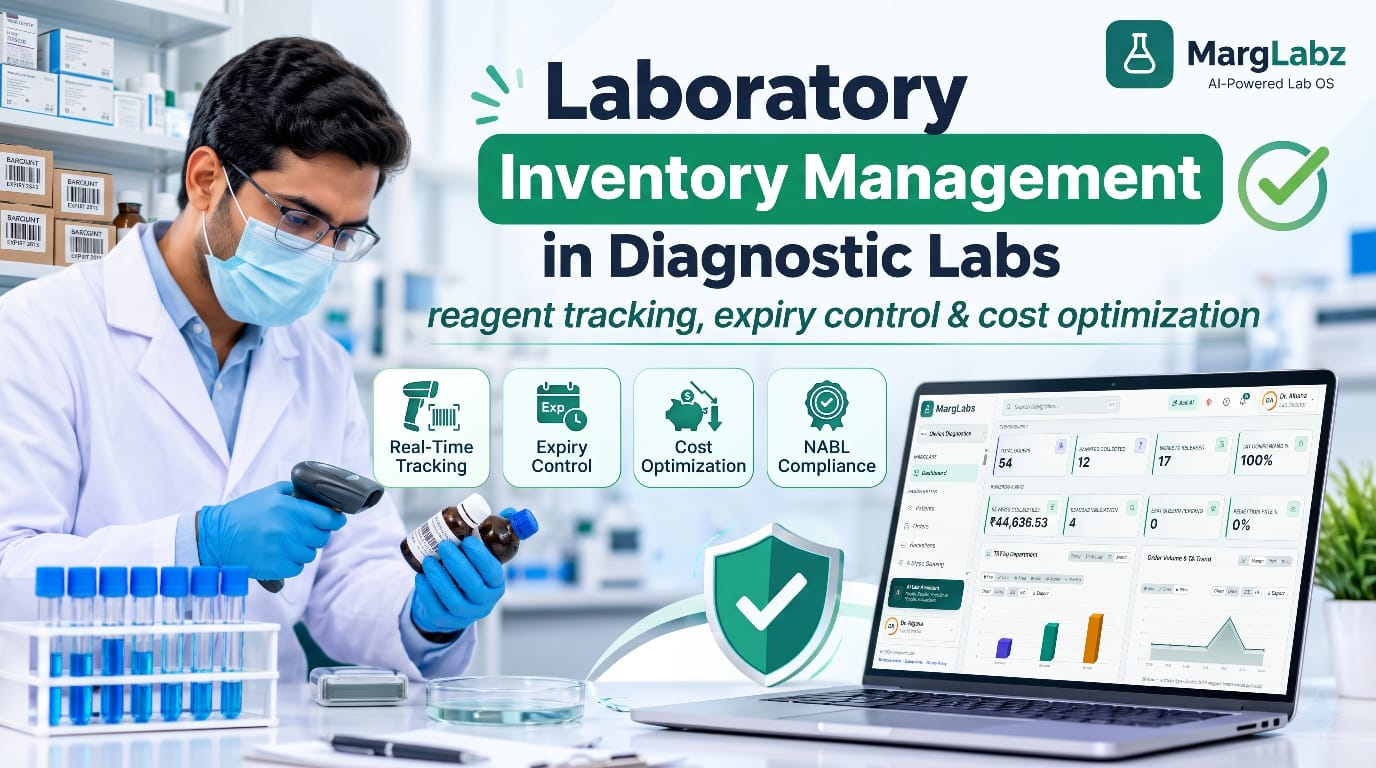
A laboratory technician opens the final chemistry kit for the week on Friday afternoon and realizes that the next shipment of kits has not yet been ordered. Additionally, there is a large order of kits purchased three months earlier that is about to expire. These two issues can both be traced back to an issue with inventory control - there was no one actually keeping track of the inventory. Inventory management in a laboratory setting involves knowing exactly what you have in stock, where it is located, when it will expire, and how quickly you go through your inventory.
By managing your inventory, you are able to ensure that you do not run out of chemicals needed to perform testing and that you are not investing money into chemical inventory that is going to be disposed of due to expiration. For a laboratory that performs multiple types of tests across various collection sites, inventory management is a cost-effective way to manage expenses as reagents make up a significant portion of the cost of each individual test.
What Is Laboratory Inventory Management?
It is a systematic approach to managing the receipt, storage, and utilization of chemicals (reagents), other materials (consumables) and equipment (supplies), as well as their final disposition. A key component of this process is the documentation of quantity, lot number, expiration date, and location of each item. This process is different from typical warehouse management in three ways. First, some items may become unusable due to expired shelf life or improper storage. Second, all results obtained using an item should be linked back to the specific lot that generated those results. Third, although items are used primarily for testing patients, they are also consumed in support of various quality assurance activities including calibration, quality control, and repeat testing.
Types of Inventory Used in Diagnostic Laboratories
| Type | Examples | Watch-point |
|---|---|---|
| Reagents and chemicals | Analyzer reagents, stains, buffers | Lot, expiry, storage, opened date |
| Consumables | Cuvettes, tips, slides | Compatibility with the instrument |
| Sample collection materials | Tubes, needles, containers | Right tube type, expiry |
| QC materials | Control sera | Lot changes, storage |
| Calibrators and standards | Calibrators | Lot, stability once opened |
| PPE and general supplies | Gloves, sanitiser, waste bags | Sizes, steady availability |
Why Effective Inventory Management Matters in Diagnostic Labs
The first reason for using an automated inventory management system is simple testing will continue. If you run out of one reagent, your entire test panel will stop. It will be more expensive to order reagents immediately than to order them as planned. Cost control is another benefit. Expired reagents and ordering too much are both wastes of money. Automated inventory systems allow you to see what is currently in stock at each of your sites. This visibility helps with both quality control and traceability. For example, if there is a question about a laboratory result, you can find the reagent lot number used to produce that result. Finally, automated inventory systems use consumption data to turn reagent ordering from a guessing game into a planned activity.
Common Laboratory Inventory Management Challenges
All laboratories begin their inventory systems using manual stock registers and they all encounter many of the same issues. Manual stock registers do not record consumption therefore, the stock register becomes different from the actual stock on the shelves. Expiration dates on boxes are never checked. Re-ordering levels only exist within the minds of laboratory personnel, which means stock-outs can happen suddenly.
When there are partial kits, transfers of kits between branches/collection centers or returns of kits to branches/collection centers, the quantity of kits will be incorrect. Batch information is not recorded in manual stock registers, therefore, when there is a question about a particular batch, it is difficult to determine where that batch came from. Finally, purchasing records for laboratory supplies are maintained separately from records for usage of those supplies; therefore, it is impossible to determine whether the amount of supplies purchased was consistent with the amount of supplies used.
How to Manage Reagent Inventory Effectively
The first step is to record the lot number and expiration date of all products upon their arrival. This will allow us to correlate when those products were being used with the time frame they were received. We should also store copies of our supplier's and buyer's purchase orders, along with invoices, delivery dates, and lead times. When we receive a product, we need to inspect the outer packaging for any damage, verify that the labels are intact, confirm that the quantity matches what was ordered, and note whether there are temperature indicators present (e.g., dry ice) and if so, how well they have functioned. After completing this inspection process, we must store the product according to the manufacturer's instructions. In addition, we must maintain a record of refrigerator/freezer temperatures and the dates they were checked.
As part of our tracking process, we must record the date we open each package of reagent and adhere to the manufacturer's stated stability period. To help us identify potential issues related to excessive or insufficient use of materials, we should monitor our usage rate of reagents by comparing it to the total number of tests performed. Purchasing and inventory control is considered one of the most critical aspects of developing and maintaining a high quality laboratory system as stated in the WHO Laboratory Quality Management Handbook.
FIFO vs FEFO in Laboratory Inventory Management
| FIFO (first in, first out) | FEFO (first expired, first out) | |
|---|---|---|
| Rotation basis | Order of receipt | Earliest expiry date |
| Works best for | Items with similar shelf life | Reagents and kits with varying expiry |
| Example | Older glove cartons used before new ones | A newer kit expiring in June is used before an older kit expiring in September |
| Risk | Newer stock may expire first | Needs expiry dates recorded accurately |
Expiry-date based rotation works well for most reagents since they have varying expiry dates due to different lot numbers. Follow all manufacturer guidelines: you may require verification after a lot change (pursuant to your SOP) do not combine reagents from different lots in one assay run and reagents can last longer if used before the stated expiry date.
How to Track Reagent Expiry Dates and Prevent Wastage
Review stock on a regular basis (such as monthly) to check for expiration. Flag items that will expire during a period defined by your SOP. Place near-expiry items in the front row of the storage area. Inform the bench about these near-expiry items. Remember to follow the manufacturer's recommendations regarding open-container stability as it may be shorter than the printed expiration. Ensure that the storage environment remains within the recommended temperature ranges. Heat damage to products can render them useless prior to their expiration date. Document each product discarded including its lot number, amount discarded, date of discarding, and the reason why the product was discarded. This will ensure that all product loss data is accurate.
How to Calculate Laboratory Inventory Requirements
Monthly Consumption = Opening Stock + Purchases − Closing Stock
Reorder Point = (Average Daily Usage × Supplier Lead Time) + Safety Stock
For example purposes only, not a benchmark. A kit contains 200 tests. The lab begins the month with 6 kits. They purchased an additional 8 kits during that time period and had 5 kits left at the end of the month. Consumption was 6 + 8 - 5 = 9 kits consumed in 30 days. Average daily use would be 0.3 kits. The supplier takes 7 days to ship. The lab maintains 3 days worth of use as safety stock (0.9 kits). Reorder Point = (Average Daily Use x Shipping Time) + Safety Stock Reorder Point = (0.3 kits/day x 7 days) + 0.9 kits Reorder Point = 2.1 kits + 0.9 kits Reorder Point = 3.0 kits The lab places another order once their inventory level drops below 3 kits.
The amount used is measured based upon what was actually consumed, not on the number of tests that were reported. Actual consumption has included calibration, internal quality controls, repeat testing and dead volume. At a price of ₹12,000 per kit, nine kits will equal ₹1,08,000. Out of those nine kits, there were 1,440 reportable tests, therefore, the reagent cost equals ₹75 per reportable test, which is not equal to ₹60 as would be calculated when taking the price of the kit and dividing it by the 200 tests indicated on the box.
How to Reduce Reagent Wastage and Inventory Costs
Match the kit size to your monthly volume, so that you use all of each open pack prior to the end of its stability period. Do not run a low-volume test on more than one analyzer, because this will require you to use multiple partial kits. Batch your routine runs so that you can share control and calibration across more patient samples. Reduce avoidable repeat tests by reducing the number of samples rejected. To learn how to reduce sample rejection rates, view our Guide to Reducing Sample Rejection Rates. If your supplier permits it, pool your branch orders, and negotiate for delivery of stock with longer shelf lives. Use our Guide to Calculating Reagent Cost per Test to track your reagent cost per test.
Laboratory Inventory Audits and Stock Verification
The purpose of an audit is to verify that the information listed in the organization's documentation matches the actual physical inventory present. You should perform regular sample counts of your inventory, however, you may wish to count faster-moving and higher-valued items more frequently. Your organization will determine how frequently you should conduct a complete count of all inventory. When you identify a difference between the information provided in the documentation and the results of your counts, you must investigate the cause of the discrepancy.
Some potential causes include unrecorded issues, transfers, partial kits, and receiving errors. Once you have identified the source of the discrepancy, you must update both the organization's records and its processes. Finally you must reconcile your batch records with your purchase and usage data. You can decide how frequently to perform these activities based upon your level of risk and turnover. There are no mandatory intervals for performing audits.
How Laboratory Inventory Management Software Improves Efficiency
The benefits of using software include providing real-time stock availability, tracking lots and expiration dates, receiving notifications of expiring stock, recording issues and usage, alerting you when your stock falls below re-order levels, keeping track of your suppliers and purchases, generating reports, and if you are part of a chain, viewing the stock of each store. A cash register is just a way for someone to record what they can remember. A spreadsheet is used to store data such as numbers. However, a spreadsheet does not provide any type of alert system or audit trail. Also, a spreadsheet can break if multiple users try to make edits to the spreadsheet. A system that is designed to manage stock links the stock to the receipt of goods, the issue of goods, and testing of goods.
MargLabz is a Laboratory Operating System (OS) powered by artificial intelligence. Its website states that it has 40+ different modules, including: - Batch/expiry tracking for reagents/consumables - Cold chain monitoring (to log excursions) - Cost per reportable test view - From the Growth Plan upward Stock/Inventory Management with MIS/Insights Reporting. If you ask any vendor about how reorder alerts, consumption records and multi-branch stock are managed, they will tell you.
Best Practices for Effective Laboratory Inventory Management
- Record lot and expiry at every receipt.
- Use expiry-based rotation, within manufacturer instructions.
- Label opened packs with the date.
- Set reorder levels from actual consumption.
- Review expiring stock monthly.
- Investigate every stock discrepancy.
- Keep purchase and usage records together.
- Monitor storage temperatures and act on excursions.
- Review reagent cost per test monthly.
- Train staff and name an owner for each store.
Putting It Into Practice
Laboratory inventory management pays back quickly: fewer stock-outs, less waste and better numbers for pricing. Start by recording lots and expiry at receipt, then calculate one reagent's reorder point from real consumption. Looking to streamline your diagnostic laboratory operations? Explore MargLabz and book a free demo to discover smarter laboratory management.