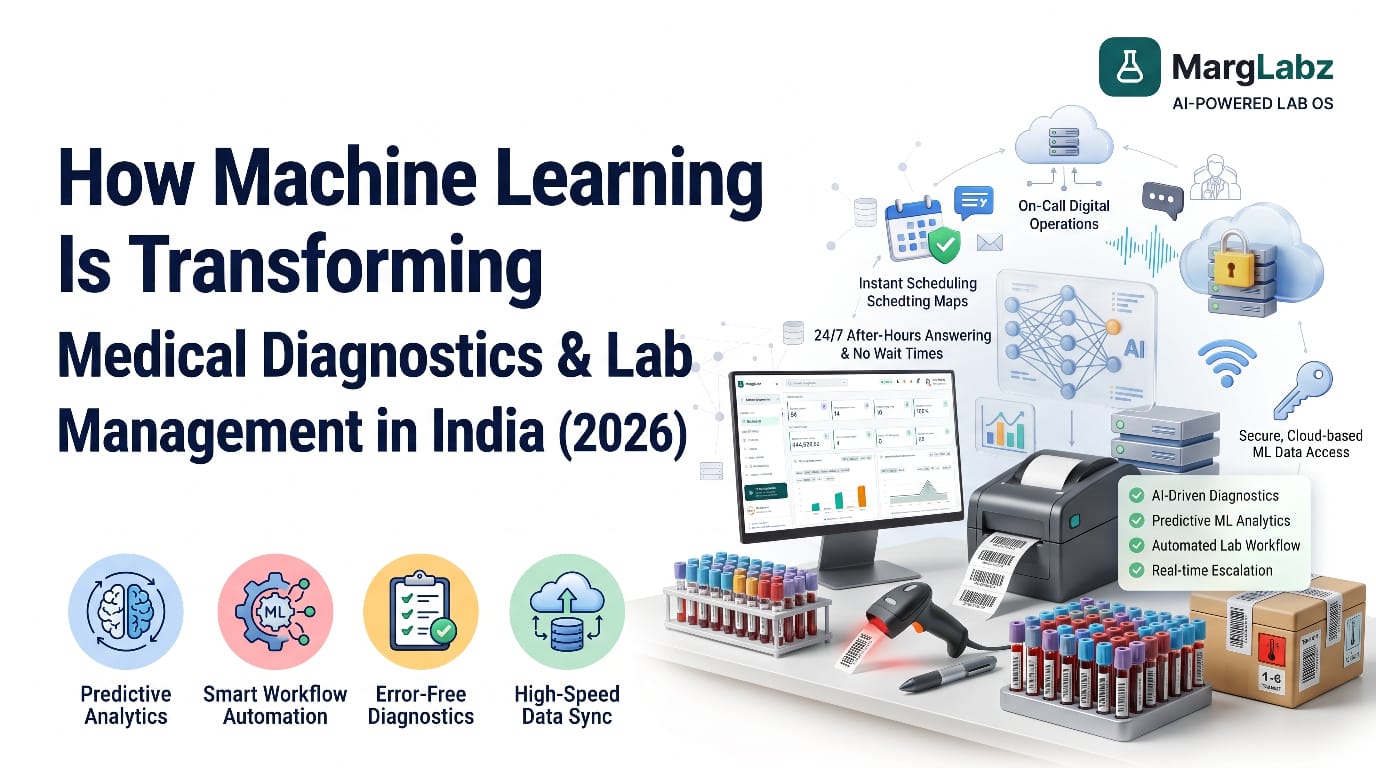
The use of machine learning (ML) in medical diagnosis involves the development of software programs which have the ability to identify patterns within large sets of data. These patterns can then be utilized to assist with various laboratory processes including the identification of abnormal results, the classification of samples, and the analysis of image-based assessments. ML-based diagnostic tools do not make diagnoses independently nor do they substitute for pathologists. However there is growing interest in the potential of ML technology due to several factors: first laboratories generate vast amounts of structured data second a recently published review of routine laboratory medicine outlined numerous examples of ML being applied to automate processes, optimize test utilization, and facilitate interpretation of results, third, the review stated that ML was still in its infancy.
For Indian diagnostic laboratories facing an increase in volume and reduced availability of expert resources, the key issues are: what areas of laboratory practice are mature in terms of using ML what areas are experimental, and how does ML relate to day-to-day operations of the laboratory.
What Is Machine Learning in Medical Diagnostics?
Machine learning (ML) is an area within artificial intelligence (AI) where algorithms are developed to "learn" from examples rather than being solely programmed with a list of hand-written rules. Most clinical laboratory ML applications utilize supervised learning. In supervised learning, a model is first trained using examples previously classified by human experts after training the model can predict the classifications of new unclassified data. Supervised learning contrasts with automated systems based upon fixed sets of rules (e.g., "if potassium exceeds X, flag it") as the former continuously improves its predictive capabilities through learning while the latter cannot adapt or change over time.
How Machine Learning Works in Medical Diagnostics
A project typically goes through four phases: gathering the data, preparing/cleaning the data, training the model, and then validating the model using data that was never previously used to train the model. The Archives of Pathology & Laboratory Medicine warning stated that there are possible problems during all four phases which could lead to results that appear to be better than they really are or suggest the model performs much better than it actually does. The quality of a model depends upon the quality of its training data and how well it is validated.
Major Applications of Machine Learning in Diagnostic Laboratories
- Workflow assistance: forecasting peak periods of demand for your services and identifying which samples may be delayed. Since there is no single source of evidence, contact your vendor to obtain documented proof of performance.
- A way of identifying unusual patterns through a combination of results and/or establishing individual reference ranges as described in the review.
- Quality Control Assistance: Detecting when a QC or instrument drifts away from its baseline, and identifying whether there are pre-analytical issues such as hemolysis, icterus or lipemia in the sample. These are often the first types of problems that occur before analysis can begin.
- Predictive analytics: estimating test volumes reagent use or likely no-shows.
- Image Analysis: reading either blood smear slides or digital pathology slides to help a human reviewer.
For instance a central lab that receives specimens from multiple collection sites might be able to create a model for predicting volume so they can schedule technicians' shifts during the peak hours of Monday morning, however, this would take several months of collecting clean time-stamped data.
Machine Learning in Pathology Laboratories
In digital pathology, glass slides are scanned into whole slide images (WSIs). Deep learning models a subtype of machine learning used on images can then be applied to quantify features on the slides or to prioritize cases for review. According to a peer-reviewed article about digital pathology models that will have clinical utility must be able to generalize across variations in staining and image artifacts. Additionally since many Indian labs primarily utilize glass slides today, successful adoption of digital pathology will require not only the acquisition of scanners but also storage capabilities and validation processes. Ultimately it is the pathologist who makes all final decisions.
AI in Blood Test Analysis and Medical Imaging
Studies have used machine learning (ML) on standard blood counts to predict outcomes and help with diagnoses, but according to one article this field is in the "infancy" stage. In several areas of medicine image-based ML models have progressed faster however the Indian Council of Medical Research (ICMR) requires clinical and field testing prior to applying these models. Use published results of model performance as a reference point for what is possible with your data not as evidence that the model will work well in your laboratory. An example: if you develop an ML model that identifies a blood count pattern that warrants pathologist evaluation then the model provides an "assistive flag" rather than a diagnosis. It is up to the pathologist to determine whether a smear review or other diagnostic tests are necessary.
How Predictive Analytics Supports Early Disease Detection
The process of using data to assess potential risks is referred to as predictive analytics. Many labs currently define "prediction" as trend analysis, which involves looking at trends within a patient's lab results across multiple visits. This can be very useful for doctors when they see a trend that may require further examination. However true machine learning risk models will need to be prospectively validated and interpreted by clinicians prior to being used by individuals for early detection purposes.
The Role of Machine Learning in Laboratory Management Software
The LIS (Laboratory Information System) is the system of record for orders samples and results. ML then adds an analytical layer on top of this data. Examples include demand forecasting, re-order suggestions for reagents, Turnaround Time anomaly alerts and Quality Control trend warnings. However ML can only work with clean, connected data. This includes barcoded samples, interfaced analyzers, and consistent test master files. Our guides on Barcode Sample Tracking and Common Laboratory Management Challenges provide the foundation required to create this environment.
Benefits of Machine Learning for Diagnostic Centres
- Staff attention goes to exceptions instead of every routine result.
- Monitoring of QC volumes and stock becomes more consistent.
- Planning for staff reagents and analyzers improves.
- Trends become easier to show to patients and doctors.
These benefits depend on validated models and good data. None is guaranteed.
Challenges of Machine Learning in Healthcare
- Data quality: incomplete or inconsistent records weaken models.
- Patient Privacy: Health Data is Sensitive. Please discuss the DPDP Act, 2023 with your attorney.
- Bias of algorithm: A model created using data that does not represent all groups will likely have poorer results for certain groups. ICMR's guidelines emphasize equality and no bias.
- Clinical validation: test any tool on your own patient mix before relying on it.
- The costs of establishing integrating, and training staff on new technologies will require a substantial amount of time. Therefore it is recommended that the technology be tested in a small-scale trial (pilot) prior to expanding its use.
- The World Health Organization (WHO) has provided guidance regarding the use of Artificial Intelligence (AI) for health care. This guidance places emphasis on human oversight of AI and human accountability for its actions.
Future of Machine Learning in India's Diagnostic Industry
The first wave of assistance from digital tools is expected to be in areas like flagging, triage, summarization, and forecasting human decision making remains the primary mode of action. As ABDM provides digital records that are connected to analysis systems and use common format specifications like FHIR the quality of data available for digital tools to work with is likely to improve over time. Since there is currently no formal regulation regarding the use of these types of tools it is recommended that you maintain a list of all of the tools you utilize, along with documentation demonstrating their validation. Those laboratories who address issues related to barcoding, system integration, and record keeping today will find themselves in a more advantageous position to assess the value of machine learning (ML) based tools at a later date.
How MargLabz Supports Smarter Diagnostic Laboratory Management
MargLabz is an artificial intelligence-based Lab Operating System (Lab OS) for medical labs. According to the MargLabz website, the platform includes 40+ different modules covering everything from registration through reporting, bar-code based sample tracking bi-directional analyzer connectivity automated validation based on rules and delta checking with automatic exception reporting to people, quality control with Westgard Rules, billing inventory management, ABDM/ABHA support, and a Patient CRM. MargLabz' AI Smart Report includes both the pathologist signed clinical report as well as clear language explanations and trends for each test result. Additionally, the Pricing Page for MargLabz lists AI features including AI Quality Control and AI Analyser Monitoring under the Professional Plan.
MargLabz does not provide diagnostic services for illnesses and the AI Smart Reports are not intended to serve as a substitute for Pathologists. When you schedule a free demo, please inquire about which aspects of the system employ machine learning technology, how those systems were tested/validated, and what aspects are based upon rules. To schedule a free demo, please click here.
Conclusion
Machine learning (ML) used for diagnostic purposes should be viewed as an assistant. ML excels at sorting data, identifying potential issues (flagging), and making predictions based upon previous data. ML has limitations when validating the results. It would be most effective for labs in India to develop a robust system of collecting clean data and developing well documented processes before implementing AI tools that can provide validation and allow pathologists to continue to manage the process. Laboratory Management Software (LMS) should be evaluated according to how well it supports this approach.