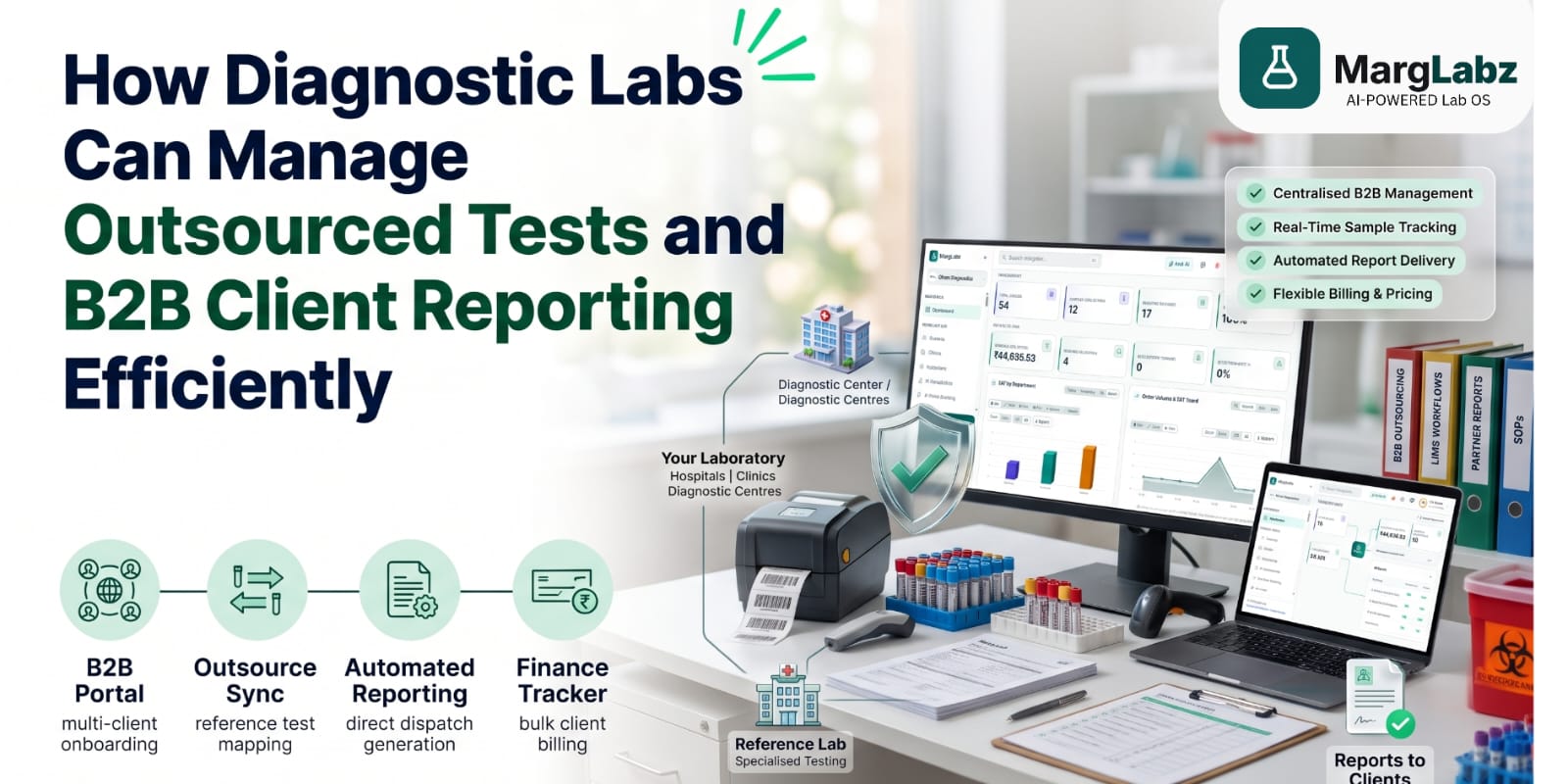
The time is now 6:30 PM. Over the course of today, your laboratory received samples from eleven different client laboratories and collection sites. Of those eleven, three require a special type of testing that is not available at your facility therefore, those three samples will be sent to a reference laboratory. Two times, a single client called to inquire about the status of his/her sample. One client was upset about the price charged for their testing services. In addition, there are over 200 unread messages in the laboratory's WhatsApp group. Lastly, you have to be mindful of what reports are scheduled to be completed by tomorrow morning.
Any person operating an expanding business-to-business (B2B) diagnostic firm should be familiar with this. Handling the management of contracted laboratory testing is easy enough to do when you have about ten to twelve per week. However, when you start handling one hundred per day, with each being handled by several different clients, it turns into an operational issue. Most of the errors are minor, i.e., incorrect test codes used, samples lost or not tracked, the rate for testing not updated, and reports delivered to the wrong individual.
This guide provides a practical approach to managing outsourced testing services, client laboratory testing, sample transport, billing, and report generation using a single system. In addition to providing a workflow for these areas, this guide will provide examples of how laboratory management systems can help support these activities as well as some limitations that may occur with their use.
What Is Outsourced Laboratory Testing?
The process of sending a patient sample, or a laboratory test order, to a different lab for processing (as opposed to being processed at your own facility) is called "outsourced laboratory testing." This occurs when a laboratory does not have the capabilities to perform a specific test. After receiving the sample, the other lab will process the sample and return the results back to your lab. Depending on how you set up the arrangement with the other lab, your lab may then generate the final report for the client/patient.
Two terms matter here:
- In-house tests: completed on your own analysis equipment, with your own personnel, according to your own quality management system.
- An outside test (referral test) is completed by an external lab: You are still responsible for the referral process, regardless of whether you are actually completing the testing yourself.
Client labs vs. Reference labs. Client labs send work to you. Reference labs receive work from you. Most labs do both. A medium-sized pathology lab will send routine samples to small clinics and collection sites and then refer specialized testing (e.g., advanced immunology or genetics) to a larger reference laboratory.
A practical example. Your lab receives a sample from a clinic for a standard panel and a single special test. You perform all the standard tests at your facility. The special test is sent to another lab that you have a partnership with. After performing the special test, the other lab returns the results to you. Once you receive all of the results, you review them and then provide the clinic with a single report containing all of the results. This is an example of a B2B lab workflow. Every step of this process has the potential to fail.
Why Do Diagnostic Laboratories Outsource Certain Tests?
Laboratories often contract with third parties for testing services as opposed to conducting each service on-site. Here are some of the most common reasons why labs may choose to utilize an outside provider for testing services:
- Specialized laboratories. Some tests require specific equipment, validated testing procedures or expert knowledge, which is found only in a small number of labs.
- Lower cost of ownership. The purchase and upkeep of a sophisticated analyzer is economically feasible only at or above a specific level of testing.
- Improved utilization of resources. Staff and instrumentation can be focused upon the routine, high-volume tasks.
- With a wider menu of tests available for your clients, you have the ability to offer them an expanded list of tests even though you don't possess all of the technologies required to perform those tests.
- A special collaboration. A reference laboratory can offer you the technical knowledge that your team does not possess.
When you use outsourcing as part of your business model, it is crucial to remain grounded in reality. Outsourcing will not inherently enhance accuracy or reduce the amount of time needed for a job to be completed. According to industry feedback (such as the Lab Manager's "In-House vs. Outsourced Testing" article), outsourcing results in additional transit times, waiting periods, and delays in communicating with the vendor. Therefore, outsourcing benefits companies economically and provides them with access to resources they may otherwise not have, but does not provide benefits related to speed. For this reason, it is essential to monitor and track the progress of each outsourced project.
This problem is very prevalent. In fact, a survey by Medical Laboratory Observer showed that the majority of labs have outsourced some of their lab tests to other labs. The survey was done with labs in the United States; therefore, use it as a guide for India.
Common Challenges in Managing B2B Laboratory Operations
When outsourced testing grows, the same problems tend to appear:
- Orders are received from. various sources such as telephone calls, e-mails, WhatsApp messages, hard copy requisitions, and spreadsheets. All of these require manual data entry.
- Manual entry of data and duplicity. Typing patient information and testing procedures results in errors and multiple copies of the same order.
- The identification of weak samples. If a tube is labeled by hand, tracing that tube at a later date can be very difficult.
- Coordination issues. The client laboratory and the reference laboratory do not know the exact location of the sample.
- Rate confusion. Each client may have a different price list and rates change.
- Tracking payments and credits. It's difficult to track who owes what and how long they've owed it when you're using spreadsheets.
- Late reporting. Delay is only noticed after a customer reports it if you do not track turnaround times.
- Communication gaps. Status updates depend on someone remembering to send them.
The vast majority of the problems listed above are not clinical problems. These problems are considered to be workflow problems. Workflow problems have a tendency to be resolved with the use of a structured approach.
How to Manage Outsourced Lab Tests Efficiently
Short Answer: A single controlled workflow (order through invoice) where each outsourced test is identified, associated with a processing laboratory, assigned a unique identifier (barcode), monitored, assessed for quality, reported, and charged to the customer using a single record.
A practical nine-step process:
- Get test orders from your laboratory clients. Use a single way to accept orders (e.g., via a client portal, a structured upload, or at the front desk), rather than receiving orders by phone or through a messaging system.
- The process of registering samples and verifying their associated information will be performed upon receipt. At the time of sample entry into our system we will verify the patient's identity (name), the ordered tests, the type of sample being submitted for testing, and the date/time the sample was collected. Any errors made during this initial verification process may result in lost time for us to correct the error. However, errors found in the report once it has been sent out may cause us to lose credibility with our customers.
- Each test should have its correct laboratory assigned. For each test, there must be a rule specifying whether it will be performed internally (in-house) or sent to a specific external reference laboratory. These rules should be documented within the test catalog, rather than relying on the memory of staff members.
- Create unique identification for each sample. A barcode is generated for each sample and associated with the order. This is what creates traceability.
- Maintain a log of dispatch and arrival. Document when the sample was sent from your facility, who transported it, and when the reference laboratory received it.
- Monitor the testing process and when you expect to receive a response. When you send your sample to the lab, establish a target date for the delivery of results. Then, be on the lookout for any samples that will soon exceed or have already exceeded that target date.
- Verify and confirm the results. Before releasing the result, ensure it is associated with the correct patient, test, and units. While the laboratory providing the reference service will generate the result, you have determined which of those results will ultimately reach the customer.
- Provide the final report back to the laboratory that requested it. Utilize a controlled method of transmission to ensure that each individual client obtains their respective report, and the transfer of the report can be documented.
- Keep track of billing and transactions. Create invoices for clients, document the expense associated with outsourcing testing services, and maintain visibility into payment status.
An example. A client laboratory orders a panel with a single test referred. At step 3, the system recognizes that there's a test referred and then directs that test to the other partner laboratory. At step 6, the estimated report date is established. If the partner laboratory doesn't indicate receipt of the sample within the time frame agreed upon, a staff person will follow up with the partner laboratory the very same day—not three days later.
How to Manage Multiple B2B Client Laboratories
Each of the numerous clients that you will eventually work with should be treated like a customer and not just a telephone number. The best ways to manage your client's laboratory effectively are:
- Centralised customer records. All of your customer's contact information, agreements, and historical data are stored together.
- Individual client accounts and logins so each client sees only its own data.
- Client-wise test catalogues. Not every client orders every test.
- Client-specific pricing. Contract rates, volume discounts, and special packages.
- Order history and status. Clients can see what they sent and where it stands.
- Credit limits and current debt levels visible prior to accepting new work.
- Client Performance Monitoring. Volume, Turnaround Time, Rejections, and Recalls per Client.
- Clear communications. Status is open by default; therefore, clients will not have to inquire.
The advantage is less "chasing" and greater consistency. Clients who can self-serve are calling in less frequently.
Why Sample Tracking Is Critical in Outsourced Testing
Your samples are still your responsibility after they leave your facility. Your clients will hold you accountable for any delays, damage, or identification errors with their samples, regardless of who caused them (i.e., the courier).
Good sample tracking in outsourced testing records:
- Identification: a unique barcode per sample, linked to the order.
- Dispatch record: date, time, packaging condition, and handler.
- Receipt confirmation: acknowledgement from the receiving lab.
- Status updates: received in process, result awaited, result received, reported.
- Traceability: the full chain from collection to report.
- The escalating process for delayed samples: there should be a clearly stated rule (for example, if a sample hasn't been confirmed received within a certain amount of time, an alert will be sent).
Bar codes decrease the number of times items are misidentified; however, this only occurs when bar codes are printed correctly and then read/scanned during each step of the process. If a bar code is created and then never read/scanned, it will have no impact.
How to Simplify B2B Laboratory Billing and Margin Management
Billing is where B2B operations quietly lose money. Three prices are involved in every outsourced test: what the client pays you, what you pay the reference lab, and what remains.
| Element | What to track |
|---|---|
| Client-specific price | The contracted rate for that client and test |
| Reference lab cost | What the partner lab charges you |
| Margin | Client price minus reference lab cost, before your own handling costs |
| Invoice | Consolidated or per-order, with correct tax treatment |
| Credit | Limit per client and days allowed |
| Outstanding | Ageing of unpaid invoices |
An illustrative example (numbers are for explanation only). Suppose a client is billed ₹1,200 for a referred test and the reference lab charges you ₹800. Your gross margin is ₹400, or about 33%. If the reference lab raises its rate to ₹950 and you do not update the client price, your margin falls to ₹250 without anyone noticing. This is why rate lists need regular review.
Good laboratory billing management also means checking outstanding balances before accepting more work from a slow-paying client. Financial transparency here protects cash flow.
Automated Report Delivery to Client Laboratories
Manual report delivery requires that an individual download a report, find the appropriate client contact, attach the report and then send it. At scale, this is a waste of time and poses a risk of sending the report to the wrong location.
Automated lab reporting normally includes:
- Digital report generation from the validated result in a consistent format.
- Secure report access through a login-protected portal.
- Automated notifications when a report is ready.
- API-based delivery into the client's own system, where both sides support it.
- The client can retrieve old reports from report history, which means they don't have to contact you.
- Fewer manual follow-ups, because status is visible.
Lab reports contain personal medical information. Regardless of how you choose to transmit or store lab reports, make sure only authorized individuals can view them, make sure that the transmission of laboratory reports is done securely and record when individuals accessed the laboratory reports. The Digital Personal Data Protection Act of India, 2023, has made this a legal concern in addition to a business concern. Consult your legal counsel regarding your present obligations.
You also need to verify your laboratory's accreditation requirements. If your lab is NABL-accredited, then the name of the laboratory that referred you and the testing they provided must be documented in the final report. This is outlined in NABL's medical laboratory specific criteria document (NABL 112) and is covered under ISO 15189 (the standard used by NABL to accredit labs) within its section on referral laboratories. Prior to designing your report format, you should confirm the most recent version of each document.
How B2B Client Portals Improve Laboratory Operations
A lab's B2B client portal is a secure online portal (or website) that allows its client laboratories to directly communicate with it. It does so without having to call or message. When designed correctly, a client portal enables clients to:
- Place test orders.
- Upload orders in bulk, where the system supports it.
- Track sample status.
- Download completed reports.
- Review order history.
- See billing and outstanding information.
The primary benefit of having clients enter their own data into the system is that you will receive fewer phone calls at your reception desk and less error in transcribing data to your analytical instruments.
Role of Laboratory Management Software in Outsourced Testing
The various components mentioned above are integrated together by means of a diagnostic lab management software (LIS). A LIS allows all the above components to be managed from a single location. Otherwise, a client's data would reside in one file; sample tracking in another; billing in a third; and reports sent out via email.
In outsourced testing, integrated software can:
- Hold client accounts, catalogues and rate lists.
- Map each test to an in-house or a named reference lab.
- Print barcodes and record sample status.
- Generate invoices from the order, using the right client rate.
- Release reports and keep a delivery history.
- Show dashboards for turnaround and outstanding payments.
Software won't fix a bad process. You should define your Standard Operating Procedures (SOPs) before you set up the software to support those procedures.
How MargLabz Helps Manage B2B Laboratory Operations
MargLabz is a cloud-based laboratory management platform from Marg ERP Ltd. Based on the MargLabz website at the time of writing, these capabilities are relevant to outsourced testing:
| Operational need | What MargLabz lists |
|---|---|
| Outsourced test handling | An "Outsourced tests management" feature, included from the Basic plan |
| B2B clients | B2B client referral portals, listed under the Growth and Professional plans |
| B2B reference lab workflow | The B2B reference lab page describes client-lab portals, outsourced test routing and API-based result delivery |
| Sample tracking | Barcoded sample tracking from collection to archive |
| Pricing and credit | Rate lists priced per doctor, centre and panel; corporate accounts with credit limits and consolidated invoicing; outstanding and ageing reports |
| Report delivery | Reports via email, WhatsApp and SMS, pathologist sign-off before release |
| Integration | REST APIs and webhooks for connecting your own systems |
| Security | Role-based access, audit logs, and DPDP Act-aligned data handling, as described by MargLabz |
Potential workflows, not confirmed features. Bulk order upload by client labs, and automatic margin calculation between client price and reference lab cost, are not explicitly stated on the pages reviewed. Ask about them during a demo and confirm in writing before you rely on them.
A sensible way to evaluate any platform, MargLabz included, is to bring your own scenario: a client with a special rate, a referred test, a delayed sample and an unpaid invoice. Ask the vendor to show each step.
Managing multiple client laboratories and outsourced tests doesn't have to be complicated. Explore how MargLabz can help streamline your laboratory's B2B operations, sample tracking, billing, and report delivery. Visit marglabz.com or book a demo.
Best Practices for Managing Outsourced Laboratory Testing
- Write SOPs for referral. Document how tests are selected, packed, dispatched, tracked and reported.
- Keep the test catalogue accurate. Every test should show its processing lab, sample type, container and expected turnaround.
- Use unique sample IDs. One barcode per sample, scanned at each hand-off.
- Agree turnaround expectations in writing with both clients and reference labs.
- Communicate proactively. Tell clients about delays before they ask.
- Reconcile billing regularly. Compare reference lab invoices with your records at least monthly.
- Monitor delayed samples and reports daily, not weekly.
- Control data access. Give each user and client only the access they need.
- Review reference labs periodically. ISO 15189 expects laboratories to evaluate the referral labs they use.
Strong outsourced lab test management is not about one clever tool. It is about a clear process, accurate data and consistent follow-up. Software then makes that discipline easier to maintain as volume grows.