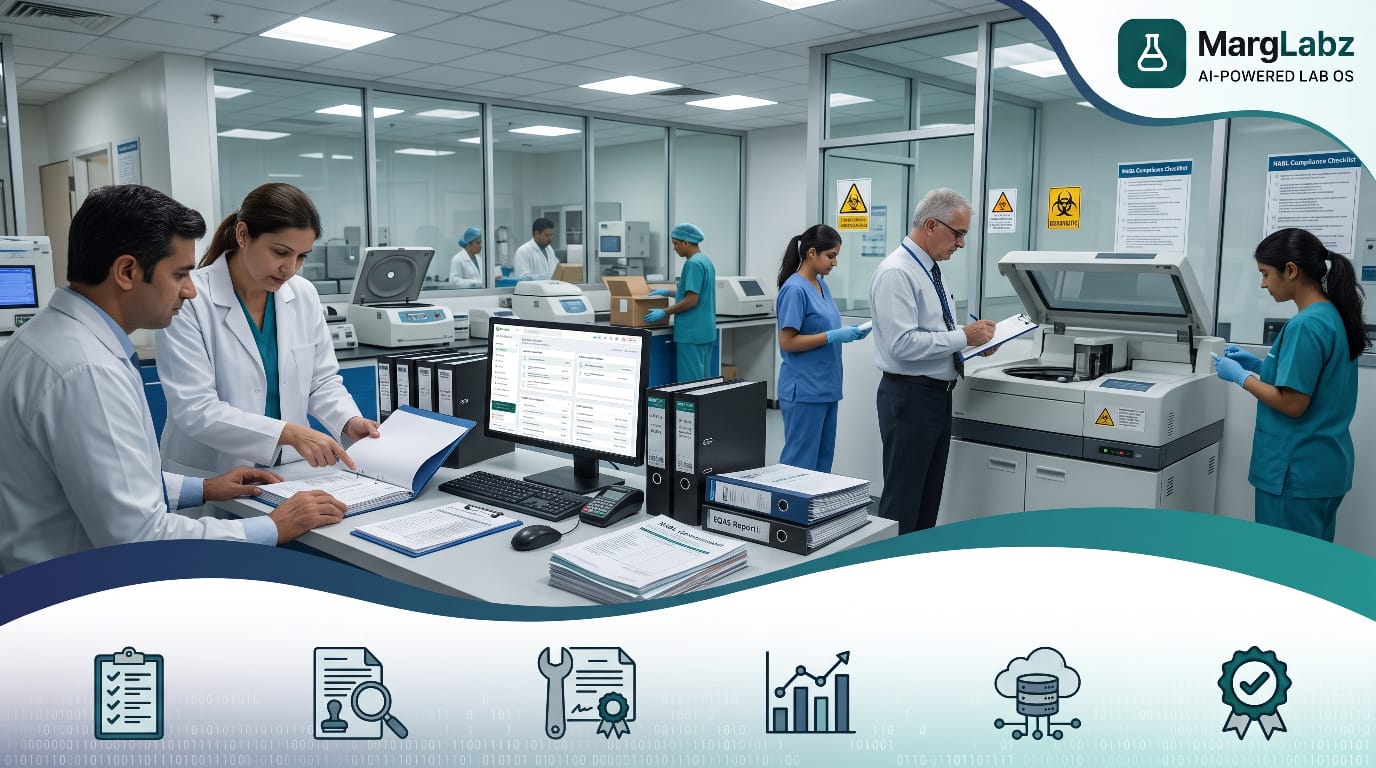
The feeling of the NABL audit being announced to your team is similar to the feeling other lab teams experience. Your team will be looking for calibration certificates, verifying whether or not the quality control sheets from last month were signed off on, and updating an SOP which has not been utilized in over two years. The week prior to the NABL audit often involves working late into the evening in the laboratory, increased levels of anxiety and stress among team members, and a substantial amount of paperwork to be completed.
It does not need to be this way. Auditors do not find labs that complete audits quickly because they are lucky or better than other labs. The reason these labs complete audits quickly is because they do quality control every day. Therefore, when an auditor comes to visit, he/she can simply look at the quality control documentation and see what work has been done.
This manual has been developed for use by laboratory owners, laboratory managers, laboratory quality managers and/or operational managers of diagnostic/pathology laboratories. It provides a list of things you should do to get ready for your first laboratory audit/evaluation, as well as subsequent audits/surveillance audits/re-evaluations.
What Does a NABL Assessment Look For?
The National Accreditation Board for Testing and Calibration Laboratories (NABL), an Indian accreditation body, uses ISO 15189 to evaluate medical labs based on quality and competence. While assessors will not hold you accountable for being perfect, they need evidence that your lab:
- Produces reliable, accurate, and traceable results
- Has competent, authorised staff
- Uses calibrated and maintained equipment
- Follows documented, controlled procedures
- Monitors its own performance and fixes problems when they appear
- Protects patients, staff, and data.
The assessment process typically involves reviewing documents, conducting an on-site visit of the laboratory, interviewing members of the laboratory team, and reviewing existing records. A way to check records is to track a single specimen or test result throughout its entire path from the time it is received until the time it is completed. This basic concept is simple: if there are no written records, you cannot prove compliance.
Start Early: A 90-Day Preparation Plan
| Period | Focus |
|---|---|
| Days 1 to 30 | Gap assessment, document review, assign responsibilities |
| Days 31 to 60 | Close gaps: update SOPs, equipment records, training, QC |
| Days 61 to 80 | Internal audit, mock assessment, management review |
| Days 81 to 90 | Fix findings, final record check, team briefing |
The process will stay consistent regardless of how near to the scheduled date you are. At this point, you should identify any missing data, fix those problems, take a practice exam with the material, and let the rest of the team know.
The Practical Checklist
1.Quality Management System and Documents
- Quality manual, policies, and objectives are current and approved
- All SOPs are version-controlled with approval date and review date
- Only current versions are available at point of use; old copies are removed
- Forms and formats are controlled and numbered
- A master list of documents exists
- Document changes are recorded and communicated to staff
- Records retention periods are defined and followed
2.Personnel and Competence
- Organisation chart, roles, and responsibilities are defined
- Job descriptions exist for every position
- Qualifications and experience records are on file
- Training records show induction and periodic training
- Competence assessments are done and recorded
- The authorisations to perform some types of operations (such as validating results) have been documented.
- Staff training records, vaccinations and health issues are all maintained in accordance with the policies you have in place.
3.Pre-Analytical Processes
- Patient preparation instructions are available and communicated
- Patient identification and sample collection SOPs are followed
- Sample labelling is consistent and traceable
- Sample transport conditions and time limits are defined and monitored
- Sample acceptance and rejection criteria are documented
- Rejections and recollections are recorded with reasons
- Collection centres and franchise points follow the same procedures
4.Equipment and Calibration
- Equipment list with make, model, serial number, and location
- Installation, maintenance, and breakdown records for each instrument
- Calibration schedule is defined, and calibration certificates are traceable
- Preventive maintenance is done on schedule, with reminders in place
- Equipment status labels (calibrated, due date) are visible
- Out-of-service equipment is clearly marked and its impact on results is reviewed
- Temperature records for refrigerators, freezers, and incubators are complete
This guide will help you manage your service records for laboratory analyzers.
5.Reagents, Consumables, and Inventory
- Reagent and consumable receipt records exist
- Lot numbers and expiry dates are tracked
- New lots or shipments are verified before use as per your procedure
- Storage conditions are correct and monitored
6.Expired or non-conforming items are segregated and disposed of properly
- Examination Procedures and Quality Control
- Method verification or validation records are available for each test
- Reference intervals are documented and reviewed
- Internal quality control is run and recorded as per schedule
- The quality control procedures have been established along with acceptance criteria. If there is a failure to meet these criteria, then the documentation of corrective actions will occur.
- The current review of the results of your participation in an external quality assessment (EQAS) program or proficiency testing.
- Unsatisfactory EQAS results are investigated and closed
- Measurement uncertainty is addressed where applicable
- Critical values are defined, and their reporting is recorded
7.Post-Analytical Processes and Reporting
- Result validation and authorisation steps are defined and followed
- Reports contain all required information and are formatted consistently
- Corrected or amended reports are traceable, with reasons recorded
- Turnaround time targets are defined and monitored
- Sample retention and disposal are documented
- The laboratory referral contract is written and the laboratory has been certified.
8.Information Systems and Data Integrity
- Software and data access are controlled by user roles
- Audit trail shows who created, edited, or released each result
- Backups are taken regularly and tested
- Patient data is protected and confidentiality is maintained
- System changes and updates are recorded
- Manual or paper records, where used, are controlled
9.Safety, Facility, and Environment
- Biosafety practices and signage are in place
- Personal protective equipment is available and used
- Biomedical Waste Segregation, Storage and Disposal Per Regulations, and Record Keeping.
- Spill kits, fire safety equipment, and emergency exits are checked
- Incidents, needle-stick injuries, and near-misses are recorded and reviewed
- Workspace is clean, organised, and suitable for the work done
10.Complaints, Non-Conformities, and Improvement
- A process exists for receiving and handling complaints
- Non-conformities are logged, investigated, and corrected
- Corrective and preventive actions are tracked to closure
- Quality indicators (such as TAT, rejection rate, and error rate) are monitored
- Previous assessment findings are closed with evidence
11.Internal Audit and Management Review
- An internal audit schedule covers all areas of the standard
- Audits are done by trained and independent auditors
- Findings are recorded and actions closed
- Management review has been held, with minutes and action points
- Customer and doctor feedback is collected and reviewed
Common Findings in NABL Assessments
Each assessment is going to be different from each other, however most laboratories should receive comments about the following:
- Outdated or uncontrolled SOPs
- Missing or incomplete calibration and maintenance records
- QC failures without documented corrective action
- Gaps in training and competence records
- Weak control of reagent lots and expiry
- Inadequate temperature monitoring records
- Incomplete biomedical waste records
- Open non-conformities from previous cycles
- Inconsistent practices at collection centres
This list will help you easily find parts of your laboratory that could have vulnerabilities.
Run a Mock Assessment
One of the most useful steps is a mock audit before the real one.
- Choose someone independent of the area being checked.
- Follow a single sample as it goes through each step of the testing process. Select a patient's laboratory report and follow the validation process, the testing performed, quality control measures taken, what type of equipment was used, what types of reagents were required, how the sample was collected, and ultimately when the sample was registered.
- Interviewing employees using similar types of questions as a certification exam would include (e.g., "How does QC fail?")
- The records must be complete (i.e., with the required details, including but not limited to, signature, date, and review mark), and not just in existence.
- I will walk through the lab to look at the labels on each container, where the items are kept, the cleanliness of the lab, how safe it is to use, and which manuals/documents are available.
- Record findings, assign owners and deadlines, and close them before the visit.
Brief Your Team
On assessment day, the people matter as much as the paperwork.
- Make sure every staff member knows their role, SOPs, and where records are kept
- Encourage honest, simple answers. It is fine to say “I will check the SOP”
- Nominate a coordinator to escort assessors and fetch documents
- Keep the lab running normally, because assessors want to see real daily practice
- Never make any changes to a record, nor should you change the date of a record. When you find that a record is missing, recognize its absence, and demonstrate the steps you will take to fill the void created by the missing record.
How Lab Software Keeps You Audit-Ready
Paper-based record-keeping can be used by an organization, however, this method requires a constant amount of labor to maintain. A well-designed Laboratory Information System will convert many of your checklist tasks into automated, regular records.
- Sample traceability from collection to report, with timestamps and user names
- Audit trails for every edit and release
- QC records with rules, trends, and flagged failures
- Equipment logs with maintenance and calibration reminders
- Document control with versions and review dates
- Role-based access that supports staff authorisation
- Rejection and error logs with reasons
- TAT and quality indicator dashboards for management review
- Backups and data security for record protection
Laboratory software and laboratory management software used today are now a standard part of everyday activities, instead of a chaotic rush just prior to an audit. Laboratory management software for diagnostic centers and centralized laboratory management systems can help multi-site networks keep consistent records at every location. To find out more about how laboratory software meets NABL quality management requirements, see our guide on the topic.
I would like to make sure that you understand that while software may assist in supporting accreditation, software itself cannot provide accreditation. Your processes, your employees, and your organizational culture are what determine if your organization is accredited.
Where MargLabz Fits
MargLabz is an AI-powered, cloud-enabled laboratory management system developed to provide solution for the expanding networks, collection centers and pathology and diagnostic laboratories. MargLabz offers daily quality control (QC) monitoring, QC monitoring, equipment and analyzer tracking, biomedical waste and safety, stock management, registration, billing, validation and reporting capabilities within one unified platform. The pricing for MargLabz starts from INR 999 per month plus GST. Prior to buying a product from any vendor, it would be beneficial to have a product demonstration and evaluate if the product features align with your laboratory's NABL requirements.
Common Mistakes to Avoid
- Starting preparation only a few weeks before the audit
- Backdating or “tidying” records at the last minute
- Updating SOPs on paper but not training staff
- Treating collection centres as outside the audit scope
- Leaving previous non-conformities open
- Relying on one quality manager to know everything
- Ignoring EQAS failures and QC trends
- Preparing documents but not preparing people
Final Thoughts
The NABL assessment preparation process is an ongoing procedure for running the lab. This includes documenting each activity performed in the lab; carrying out the documented procedures; and learning from any errors. Labs who adopt this practice will view the NABL assessments as a routine evaluation of their daily work practices, as opposed to an emergency situation.
The checklist above is a useful tool to help you find out what you are doing wrong in your laboratory and fix it prior to the time of your real evaluation. In addition, the checklist gives you a chance to do a "mock" audit of your laboratory so you have time to educate your personnel. At the time of your real evaluation, you will show everyone involved how organized, calm, and confident your laboratory runs.
You will have the ability to maintain all of your documentation, quality control, and instrument tracking current and in compliance with auditing standards each and every day with MargLabz. MargLabz offers lab management software developed for use by diagnostic and pathology laboratories, collection centers, and organizations with multiple branches. The cost of our services begins at ₹999 per month plus GST.