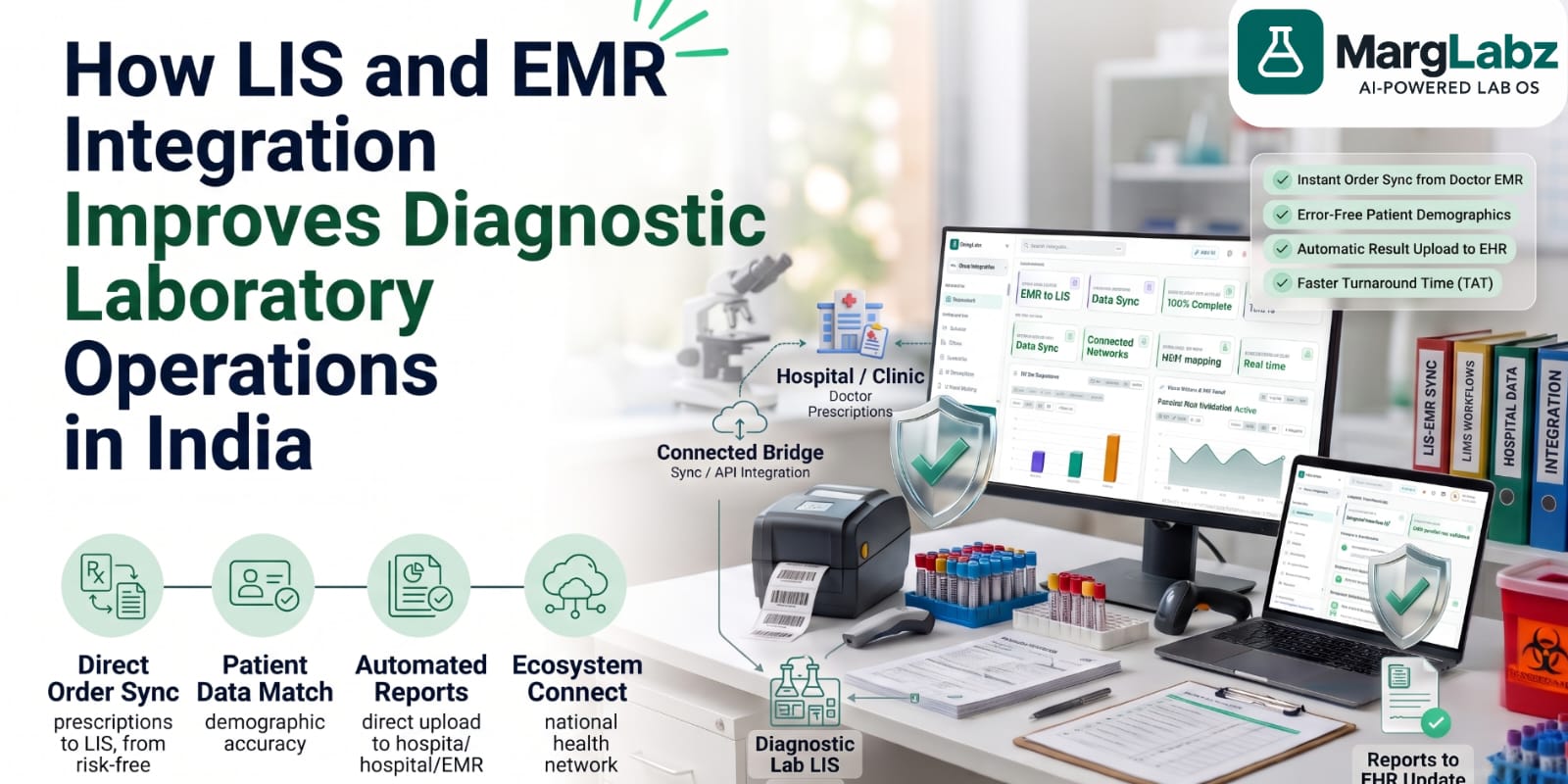
The doctor in the clinic creates a CBC order through their computer (EMR). When the patient arrives at the laboratory, the front desk types in the patient's name and the tests that were ordered based off of a piece of paper. Several hours later, either a printout of the test results is generated, or the results are sent via WhatsApp. Once the results are generated or received, someone manually attaches them to the patient's records. Although each of these steps is relatively simple, when combined they consume a great deal of time and increase the potential for errors.
Integration of EMR and LIS eliminates the hand-off process by allowing communication between the physician's computer and the laboratory's computer, enabling them to exchange orders and results directly. The integration of EMR and LIS is quickly becoming a practical requirement for laboratories in India that provide services to clinics, hospitals, and corporate clients. This article will provide an explanation of how integration works, what standards are important, and what factors should be considered prior to committing to integration.
What Is EMR and LIS Integration?
EMR and LIS integration is the automated, two-way transfer of test order and result data between a patient's medical record system and the lab's information system. This allows for data entry into one of those systems, which then moves automatically to the correct system without needing to be re-entered.
These terms are often mixed up:
- Electronic Medical Record (EMR) is a computerized version of a patient's medical file that exists within a single clinic or hospital.
- Electronic Health Record (EHR) is a larger health record designed to follow the patient among various healthcare providers.
- Laboratory Information System (LIS) is the software used to manage all aspects of the laboratory. It manages patient registration, sample labeling with barcodes, testing results from analyzers, validation of testing results, generation of reports based on testing results, and billing for services provided by the laboratory.
- LIMS is a sample and batch-centered system that is commonly used in both research and industrial laboratories. In diagnostics, many vendors refer to LIMS and LIS interchangeably.
- HMIS/HIS is a hospital-wide system that handles administration, billing and other departmental functions. In addition, it is typically linked with an electronic medical record (EMR).
How Do EMR and LIS Systems Work Together?
A typical flow looks like this:
- The doctor orders tests in the EMR.
- The order reaches the LIS as an HL7 message or an API call.
- The LIS matches/creates the patient, generates the barcode and prepares the bill.
- The sample was received and analyzed with the results being reviewed and approved by the pathologist.
- The final result, which has been approved, is returned to the electronic medical record (EMR). This process should include both the raw data from the laboratory testing in a structured format and an accompanying PDF document containing the full laboratory report.
- The doctor sees it in the patient's chart.
A laboratory that receives 40 orders per day from a referring clinic. If there is no integration between the systems, then the lab will have to manually enter each order into their own system. When manual entry occurs, the possibility exists for errors to occur, such as entering an incorrect telephone number, which could result in reports being sent to individuals who should not receive them. On the other hand, if there is integration between the systems, the front desk can view orders that have arrived prior to processing and therefore can focus on collecting samples and handling exceptions.
Some setups are not always two-way; some lab orders can be received by one lab, and some lab results can be pushed to another lab. Therefore, it is important to find out if the setup you have is for both order receipt and result delivery.
Top 10 Benefits of LIS and EMR Integration for Diagnostic Laboratories
- Fewer transcription errors: names and test codes are entered once.
- Faster registration: orders can arrive before the patient does.
- Shorter waits for reports: approved results go straight to the clinician.
- Better sample identification: barcodes come from a structured order.
- Cleaner billing: invoices follow the order, so disputes fall.
- The output of clinical data is presented to clinicians as values, units, flags, and trends—not images of scanned pages.
- Fewer status calls: clinics can see where a sample stands.
- With better traceability, you will be able to demonstrate who ordered, authorized, and distributed each item and at what time.
- Lab connections to the customer's systems will make B2B business easier.
- The new clinic client will become a defined interface instead of a manual routine.
Operational improvements do not provide guarantees for results. Results vary depending upon the way you have set up your system, the quality of your data and how your employees interact with the system.
Role of HL7, FHIR, and APIs in Healthcare Integration
- HL7 version 2: This is a well-established message format. Many times, hospitals will use order messages (ORM/OML) and result messages (ORU) within their systems.
- HL7 FHIR: A more recent, web-based standard. Resources (i.e., patients, service requests, and diagnostic reports) will be exchanged via REST. Refer to the FHIR specification. ABDM uses FHIR R4.
- REST APIs: A typical method for two systems to communicate with one another using HTTPs to obtain/provide data. Most REST APIs are unique to the company/vendor that developed them; as such, they will likely not conform to any of the existing health care standards. Therefore, review the API documentation.
- Webhooks: The LIS can inform another application when something occurs (like reporting approval) so that the second application does not have to continually ask.
- Terminology: India’s EHR Standards 2016 recommends that you use HL7 messages to share data between systems; use LOINC (Logical Observation Identifiers Names and Codes) for tests and observations; and use SNOMED CT (Systematized Nomenclature of Medicine – Clinical Terms) for clinical terms. You can make things much less confusing by mapping your test master to LOINC.
No system supports all standards automatically. Please confirm what type of messages you will be sending (and their exact versions) and then request sample messages from the system via a real-time connection from the vendor.
Common Integration Challenges for Indian Laboratories
- Many different EMRs: clinics use varied software, and some have no usable API.
- Test code mismatch: one test may carry different names in each system.
- Patient Identification: Although ABHA is helpful, many patients do not have access to an ABHA, and therefore duplication of records continues to exist.
- Small centers could lose connection with the Internet; therefore, queued messages must be resent automatically.
- Legacy reports: results sent only as PDFs cannot be analysed or trended.
- Change management: front desk employees should be trained in how to review incoming orders. Clinics should have an understanding of who to contact if an order fails.
- Ownership: agree in writing who builds, pays for and supports each interface.
Data Security, Patient Privacy and Interoperability
Your lab results contain personal, sensitive health information. Since India has enacted the "Digital Personal Data Protection Act, 2023," you may wish to consult with your attorney regarding the need for patient consent, as well as breach notification obligations. Pragmatically speaking, you will want to consider utilizing role-based access controls, encryption of all communications, authentication of all API requests, creation of audit trails, and execution of a data sharing agreement with every customer.
Patient consent is the cornerstone of ABHA-linked sharing, we have provided an explanation of the various roles associated with ABHA integration for diagnostic labs in our ABDM Integration Guide. Interoperability does not require that you share every piece of information that you collect; rather, it requires that you share only those pieces of information that each party requires. In addition, a lab should be capable of demonstrating which system transmitted or received each transaction and the time at which such transaction occurred.
How to Choose the Right LIS for EMR Integration
- Do you have a documented API or HL7/FHIR interface? If so, does it allow for both sending and receiving data?
- Can the vendor name connections already be made with client systems?
- Is a test environment available before go-live?
- Can your test master be mapped to standard codes?
- Are failed messages logged and retried?
- Are webhooks available for events like report approval?
- Are interface costs and support terms written down?
Also refer to the LIMS Selection Checklist and Lab Integration in India Guide for more information on the analyzer side.
How MargLabz Supports Connected Laboratory Operations
MargLabz is an artificial intelligence-based Laboratory Operating System (LOS) that has been developed specifically for use within diagnostic laboratories. This system is distinct from a hospital's electronic medical record (EMR) or hospital management information system (HMIS). On the integrations page of the MargLabz website, you can find a list of REST APIs and webhooks that enable connection with the clients' HMIS/EMR systems; ABDM/ABHA support as a registered Health Information Provider (HIP) using FHIR R4; and two-way ASTM/HL7 interface capabilities with analyzers.
Around the area of that site, there is bar-coded sample tracking, automatic validation with delta checks, GST billing, IQC/EQAS records and report delivery via WhatsApp after approval. The AI Smart Report will provide an easy-to-understand explanation of the clinical report in multiple languages to patients alongside their clinical reports.
The scope of what a particular EMR connection can accomplish will vary by client system; therefore, please provide the name of your client system and the interface details of that system at the time of your demonstration. To assist in developing a plan for migrating from one lab software provider to another with minimal disruption, refer to our Guide for Switching Lab Software Without Disrupting.
Conclusion
Integration of EMR and LIS allows laboratories and physicians to utilize a single copy of each order and result. Begin integrating with the most active referring clients; review both compliance and security standards; then complete testing prior to implementation. Monitor improvements in turnaround times and reductions in data entry mistakes among these same clients.