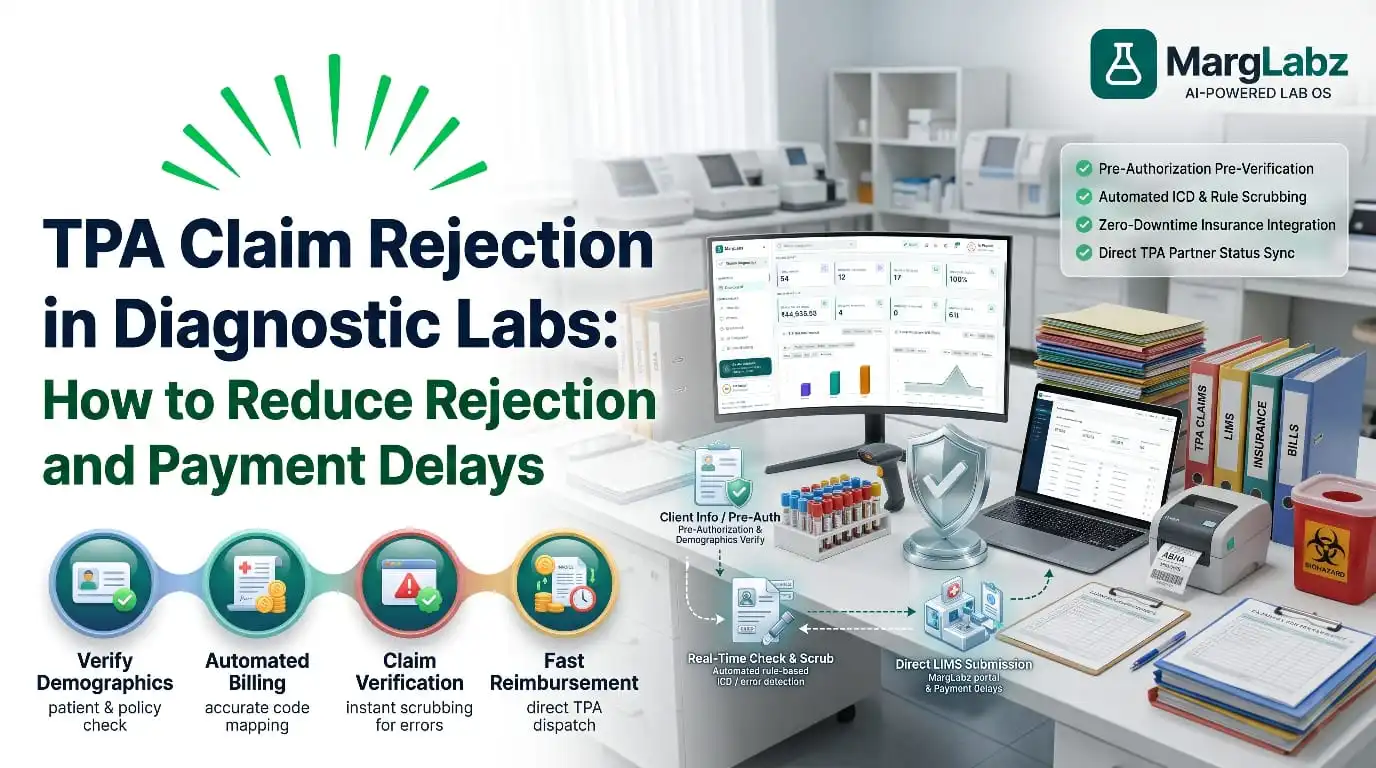
A lab can perform all tests correctly, issue all reports in a timely manner and yet wait many months for payment. The vast majority of the time, TPA claim rejections in diagnostic labs are not related to clinical issues. Most of the time they relate to paperwork and matching errors such as a name spelled differently on the card versus the invoice, a test being charged using last year's pricing, or a document that was not received by the TPA.
Quick Answer: Laboratories reduce TPA Claim Rejections through Member Verification at Registration, Billing only at Agreed Payer Rates, Sending all Required Documents for Each Invoice within the Agreed Time Frame, and Tracking each Invoice in a Claim Register until Payment is Reconciled. Most rejections can be prevented at the front desk.
How does the TPA payment process work for a diagnostic lab?
The TPA (Third Party Administrator) is a business organization that has been licensed by the Insurance Regulatory and Development Authority of India (IRDAI) to act on behalf of a health insurance provider for a fee. The main purpose of the TPA is to assist with the administration of health care services, including claim processing. Typically, there will be four parties involved in the billing process of a laboratory. These include the laboratory itself, the corporate client or policyholder whose health is being covered under the policy, the health insurance provider that assumes the risk, and the TPA that processes the claims for the health insurance provider.
Money can flow in different ways based on how you have structured your business. For example, a lab can be set up as part of a network of labs that offer cashless diagnostic services. Alternatively, the lab can submit its bills to the employer’s health check program that is managed by a TPA. Finally, if there is no other arrangement in place, the lab will provide the patient with both an invoice and results for them to use when seeking reimbursement.
The rules regarding fees, documentation, authorization procedures and turnaround times will depend on each individual arrangement. Therefore, do not assume that all payers will operate in the same manner. Additionally, you should make sure that you keep the process of handling cashless laboratory claims separate from Those for hospitals. Laboratory claims are generated at the test level and are dependent upon the rates associated with those tests. Pre-authorization is required only if specified within the terms of the agreement with the payer. (Samples submitted to you by other laboratories fall under a separate category and are explained in detail in our publication entitled Outsourced Tests and B2B Client Reporting.)
What causes TPA claim rejection in diagnostic labs?
| Claim problem | Likely reason | Corrective action |
|---|---|---|
| Member not found | Name, ID or policy number differs from the card | Verify against ID at registration |
| Documents missing | Report or referral left out of the pack | Fixed checklist per payer |
| Test name or code mismatch | Internal names differ from the agreed list | Map each test to the payer's list once |
| Wrong rate billed | Old or walk-in rate card used | Payer-wise rate cards with version dates |
| No authorisation | Approval required but not recorded | Check terms before the test; note the reference on the invoice |
| Duplicate invoice | Same visit billed or resubmitted twice | Unique invoice numbers; check the register first |
| Late submission | Invoices held until month-end | Submit weekly or within the agreed window |
| Billed vs approved gap | Rate difference, uncovered test, unclear scan | Compare line by line; raise a written query |
A rejection is loud; a delay is often quiet. Frequently it is a TPA query sitting in a shared inbox that nobody owns, while the clock keeps running. Naming one person who owns incoming queries often closes more gaps than any tool.
What steps reduce TPA claim rejections?
- Provide a single page per payer describing the rates and tests being performed by that payer, required documentation, authorization guidelines, when submissions may occur, when payments are expected from the payer, and who can be contacted for questions regarding these items. This should be kept at the billing desk.
- At registration time verify. Check to see if your first name, last name, ID, and policy/employee number match what is on the card. Obtain approval references at this point as opposed to later.
- Select the proper payer prior to billing to ensure that the correct rate card will be applied. A documented reason must accompany each manually altered rate.
- Verify each invoice with a different individual prior to sending it off. Verify that all of the following are correct on each invoice: Name, Tests performed, Rates charged, Dates of service, Total amount due.
- Submit inside the window and save the acknowledgement.
- Answer queries within a day or two and log them.
- Review rejections monthly. Count reasons, not just rupees.
What documents does a diagnostic lab need for a TPA claim?
Please note that each contract and/or payer may have different requirements. Please compare this list of initial requirements to those outlined in your contract.
- Patient or member identification matching the card or ID
- Referral or authorisation record, where applicable
- Test details with order and collection dates
- Invoice at agreed rates, with a unique number and tax details
- Released report copy, where the payer asks for it
- Other supporting papers named in the agreement
- Submission proof and the TPA's acknowledgement
- The trail of queries and replies
How do you track pending TPA payments?
Keep a list of claims (one line for each invoice): invoice number and date; payer; when submitted and what the receipt number is; when the invoice is due according to the agreement; how much was invoiced; current status; reason for rejection or question; and follow-up dates with the individual who will be handling this total amount paid and remaining unpaid. Review this list weekly, grouping the invoices that are still unpaid by age based on their agreed-upon payment terms, so you can identify invoices that are falling behind on payment as soon as possible.
How does TPA payment reconciliation work?
The amount of the invoice should be used to begin the reconciliation process. Deduct any deductions and/or credit notes from the total amount of the invoice. Compare the final amount after deductions/credit notes have been taken into consideration with the amount paid to you by the TPA. TPAs will usually pay more than one invoice at a time; therefore, you should use the remittance advice provided by the TPA to divide the total amount of the payment made to you among the individual invoices that were paid. Reconciliations should occur no less frequently than once a month. If a particular TPA is a large payer, then you may need to reconcile each time they send you a remittance advice.
How do you handle disputed deductions?
First verify if the amount deducted is correct. Check against your invoice, your rate card, and your agreement. If the error was made by the laboratory, accept it and issue a credit note; then find out why the error occurred and correct the problem. If you did not make the error, collect all relevant documentation including; the agreement clause or rate annexure that supports your claim, your order record, your report, and your acknowledgment.
Send a letter to the TPA contact person explaining that you have collected the above documentation as evidence to support your claim. Include in the letter the invoice number and the specific item on the invoice that you believe is incorrect, along with the copies of the collected documents. If the matter cannot be resolved within a reasonable period of time after sending the letter, proceed with escalation procedures outlined in your agreement. Record the dates of each step as you progress. It will help to keep a clear record of your efforts to resolve this issue, however, there can be no assurance of resolving this issue, including.
Illustrative example (hypothetical, not a real case)
Sunrise Diagnostics (a three-branch lab) sends invoices to the employer's health check program through a third-party administrator (TPA) for billing of ₹1,800/member for 120 members: ₹2,16,000. Twelve members at the desk were billed using an older rate of a ₹2,000 package (₹2,400 more), and 10 members were given an additional ₹600 test (₹6,000 more). The total amount of the invoice was ₹2,24,400. The TPA paid ₹2,16,000 based on "rate variance," and "add-on tests are not included." In addition to paying less than the invoiced amount, the TPA had asked about five members three weeks prior to payment. Those questions remained unaddressed in a shared e-mail box. an additional ₹600
The accounts executive reviewed the register. Since the ₹2,400 was an error on the part of the laboratory, she approved it and created a credit note. Since the add-on was in the annexure to the agreement, she provided that page and the ten order records for the ₹6,000, as well as updated names and identification documents. Following this, the laboratory assigned a query owner, froze payer rates, and implemented a second person review of invoices.
What does a practical TPA billing workflow look like for a growing lab?
- Register: verify identity and payer; record any authorisation reference.
- Bill: Apply the payer's rate card; invoice per visit or batch as agreed.
- Check: a second person reviews before dispatch.
- Submit: before the cutoff; keep track of your receipt; input the invoice into the system on the same day.
- Follow up: weekly review of open items; queries answered and logged.
- Reconcile & Close: match all remittances, document any applicable deductions and/or credit notes and do not close out an invoice until it is paid in full (zero balance) or written off.
Where does laboratory billing software help?
Trouble begins as branches, rate sheets, and individuals who are involved with invoices increase. Billing software can assist in several ways: by holding payer-specific rate sheets to ensure the appropriate rate is used as a standard practice; tracking invoices and partial payments; creating outstanding and aging reports; and storing record data from each of your branches in a single location (for additional resources on diagnostic lab billing software and cloud-based software for multi-branch labs, please review our previous blog posts). While billing software will help organize the billing side of your business, insurers and third-party administrators will continue to determine if claims will be approved.
Which TPA billing mistakes should labs avoid?
- No query owner, so TPA emails go unanswered.
- "Just this once" rate edits that quietly break the contract rate.
- Month-end invoice batching, which risks the submission window.
- Closing a part-paid invoice without recording the balance.
- When you accept a deduction from your bill without saying anything, then that error will occur again. This is a classic example of how to lose money on your bills.
- Applying hospital-cashless assumptions to lab invoices.
Practical checklist to start this week
- One-page summary for your top three payers
- Claim register with the columns above.
- A named query owner and a backup
- Second-person check on every invoice
- Open invoices listed by age the oldest is chased first.
- A monthly rejection review on the calendar
Conclusion
Rejections will drop if every single TPA invoice you submit is a "small" document that has to be accurate prior to leaving, the right person, the right rate, all supporting documentation included, submitted on time and followed through to payment. A system that allows you to maintain all of this information in one location becomes more critical as you continue to add more payers and/or branches. MargLabz is an AI-powered operating system for diagnostic laboratories (Lab OS). The MargLabz platform provides a view of TPA and Cashless billing with panel rates and reconciliation, corporate accounts with credit limits, and outstanding and aging views. Please ask during your demonstration how they can help you with your payers. Request a free demo.